


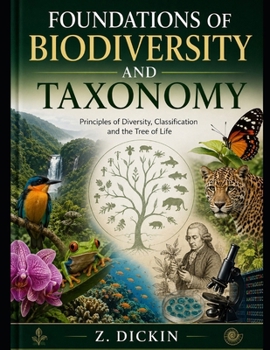
Foundations of Biodiversity and Taxonomy

Foundations of Biodiversity and Taxonomy
Life on Earth exists in an extraordinary variety of forms, ranging from microscopic organisms that inhabit the soil and oceans to the vast forests, colorful birds, and complex mammals that populate terrestrial ecosystems. This immense variety of living organisms is known as biodiversity, a concept that represents the richness and variability of life at genetic, species, and ecosystem levels. Understanding biodiversity is essential for appreciating the complexity of life on our planet and for protecting the natural systems that support human survival.
Closely linked to biodiversity is the science of taxonomy, the branch of biology that deals with the identification, naming, and classification of organisms. Taxonomy provides the framework through which scientists organize the immense diversity of life into a systematic structure. By grouping organisms according to their similarities, evolutionary relationships, and genetic characteristics, taxonomy allows researchers to understand how species are related and how life has evolved over millions of years.
The study of biodiversity and taxonomy has a long and fascinating history. Early naturalists attempted to classify plants and animals based on visible characteristics, laying the foundation for modern classification systems. One of the most influential figures in taxonomy was Carl Linnaeus, whose system of binomial nomenclature revolutionized biological classification by assigning every species a unique two-part scientific name. Linnaeus's work formed the basis of modern taxonomy and continues to influence biological sciences today.
In the centuries following Linnaeus, the field of taxonomy expanded significantly with advances in evolutionary biology and genetics. The theory of evolution proposed by Charles Darwin provided a deeper understanding of the relationships among organisms. Darwin's ideas demonstrated that species evolve over time through natural selection, and that all living organisms share common ancestry. This evolutionary perspective transformed taxonomy from a simple system of classification into a dynamic science that reflects the evolutionary history of life.
Today, modern taxonomy integrates traditional morphological observations with advanced molecular techniques such as DNA sequencing and phylogenetic analysis. These methods allow scientists to study genetic similarities among organisms and construct evolutionary trees that reveal how species are related. As a result, biological classification is continually being refined as new discoveries are made.
Biodiversity plays a crucial role in maintaining ecological balance and sustaining life on Earth. Diverse ecosystems contribute to climate regulation, soil fertility, water purification, and the stability of food webs. However, biodiversity is currently under serious threat due to habitat destruction, climate change, pollution, and overexploitation of natural resources. The loss of species not only disrupts ecosystems but also diminishes the natural heritage of our planet.
Understanding biodiversity and taxonomy is therefore not only a scientific endeavor but also a conservation necessity. By identifying species, documenting their distribution, and studying their ecological roles, scientists can develop effective strategies to protect endangered organisms and preserve ecosystems. Taxonomy serves as the foundation for biodiversity research, conservation planning, and environmental management.
Customer Reviews
ThriftBooks ® and the ThriftBooks ® logo are registered trademarks of Thrift Books Global, LLC
