


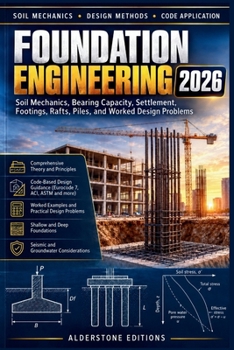
Foundation Engineering 2026: Soil Mechanics, Bearing Capacity, Settlement, Footings, Rafts, Piles, and Worked Design Problems
No Customer Reviews

A foundation does not fail because the equations looked difficult. It fails because the soil was misunderstood, the wrong assumptions were made, or a critical design check was missed.
Foundation Engineering 2026 is built to help you avoid exactly that.
Designed for civil and geotechnical engineering students, practicing engineers, construction professionals, and technical learners, this comprehensive guide connects soil mechanics theory with real foundation design so you can move confidently from ground investigation and soil parameters to bearing capacity, settlement, structural checks, and final foundation selection.
Rather than treating formulas as isolated equations, the book shows how foundation engineering decisions are actually made: What soil parameters should you use? Is a shallow foundation suitable? How large should the footing be? Will settlement control the design? When should you choose a raft or piles? How do groundwater, eccentric loading, seismic effects, and soil variability change the answer?
Inside, you will explore:
- Soil mechanics fundamentals, including phase relationships, index properties, USCS and AASHTO classification, effective stress, pore-water pressure, shear strength, and stress distribution
- Bearing capacity analysis using established methods including Terzaghi, Meyerhof, Hansen, and Vesic
- Settlement calculations, covering immediate, consolidation, and differential settlement
- Shallow foundation design, including isolated, combined, strip, and raft foundations
- Structural footing design, with flexure, one-way shear, punching shear, reinforcement, anchorage, and detailing considerations
- Deep foundation engineering, including pile capacity, pile groups, group efficiency, negative skin friction, settlement, lateral loading, and pile caps
- Pile testing and interpretation, including static, dynamic, rapid load testing, integrity testing, and load-settlement assessment
- Seismic foundation design, including liquefaction, seismic bearing capacity, dynamic soil properties, lateral spreading, and soil-structure interaction
- Code-aware design guidance referencing Eurocode 7, ACI, ASTM, national building codes, and limit-state design principles
- Worked design problems with assumptions, equations, intermediate calculations, engineering interpretation, and verification
- Practice exercises and self-assessment questions to reinforce calculation skills and design judgment
- An integrated foundation design project that brings site investigation, analysis, foundation selection, verification, and documentation together in one practical workflow
The emphasis throughout is not simply on obtaining an answer, but on understanding why a method applies, what assumptions it depends on, where errors commonly occur, and how the result influences an engineering decision.
From selecting soil parameters to checking bearing resistance, predicting settlement, sizing footings, evaluating pile groups, and designing for seismic conditions, Foundation Engineering 2026 gives you a structured reference for turning geotechnical theory into practical design.
Build your understanding from the ground up. Strengthen your calculations. Improve your design judgment. And approach foundation engineering problems with greater confidence.
Foundation Engineering 2026 is built to help you avoid exactly that.
Designed for civil and geotechnical engineering students, practicing engineers, construction professionals, and technical learners, this comprehensive guide connects soil mechanics theory with real foundation design so you can move confidently from ground investigation and soil parameters to bearing capacity, settlement, structural checks, and final foundation selection.
Rather than treating formulas as isolated equations, the book shows how foundation engineering decisions are actually made: What soil parameters should you use? Is a shallow foundation suitable? How large should the footing be? Will settlement control the design? When should you choose a raft or piles? How do groundwater, eccentric loading, seismic effects, and soil variability change the answer?
Inside, you will explore:
- Soil mechanics fundamentals, including phase relationships, index properties, USCS and AASHTO classification, effective stress, pore-water pressure, shear strength, and stress distribution
- Bearing capacity analysis using established methods including Terzaghi, Meyerhof, Hansen, and Vesic
- Settlement calculations, covering immediate, consolidation, and differential settlement
- Shallow foundation design, including isolated, combined, strip, and raft foundations
- Structural footing design, with flexure, one-way shear, punching shear, reinforcement, anchorage, and detailing considerations
- Deep foundation engineering, including pile capacity, pile groups, group efficiency, negative skin friction, settlement, lateral loading, and pile caps
- Pile testing and interpretation, including static, dynamic, rapid load testing, integrity testing, and load-settlement assessment
- Seismic foundation design, including liquefaction, seismic bearing capacity, dynamic soil properties, lateral spreading, and soil-structure interaction
- Code-aware design guidance referencing Eurocode 7, ACI, ASTM, national building codes, and limit-state design principles
- Worked design problems with assumptions, equations, intermediate calculations, engineering interpretation, and verification
- Practice exercises and self-assessment questions to reinforce calculation skills and design judgment
- An integrated foundation design project that brings site investigation, analysis, foundation selection, verification, and documentation together in one practical workflow
The emphasis throughout is not simply on obtaining an answer, but on understanding why a method applies, what assumptions it depends on, where errors commonly occur, and how the result influences an engineering decision.
From selecting soil parameters to checking bearing resistance, predicting settlement, sizing footings, evaluating pile groups, and designing for seismic conditions, Foundation Engineering 2026 gives you a structured reference for turning geotechnical theory into practical design.
Build your understanding from the ground up. Strengthen your calculations. Improve your design judgment. And approach foundation engineering problems with greater confidence.
Format:Paperback
Language:English
ISBN:B0HDJ129GC
ISBN13:9798191433394
Release Date:August 2026
Publisher:Independently Published
Length:694 Pages
Weight:1.81 lbs.
Dimensions:1.7" x 6.0" x 9.0"
Customer Reviews
0 rating
Copyright © 2026 Thriftbooks.com
Terms of Use | Privacy Policy | Do Not Sell/Share My Personal Information | Cookie Notice | Cookie Preferences | Accessibility Statement
ThriftBooks ® and the ThriftBooks ® logo are registered trademarks of Thrift Books Global, LLC
ThriftBooks ® and the ThriftBooks ® logo are registered trademarks of Thrift Books Global, LLC
