


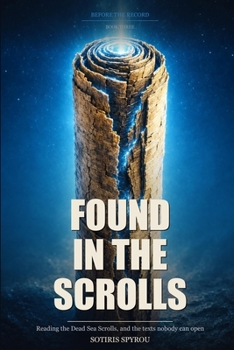
Found in the Scrolls: Reading the Dead Sea Scrolls, and the texts nobody can open

A carbonised roll from Herculaneum cannot be unrolled without destroying it. In 2023 a machine read words off the inside of one without touching it. That is a genuine and remarkable result, and it is smaller than the headlines it produced.
This book separates the two. What was actually recovered, how much of the collection it represents, what the error rate is, and whether anybody outside the project has checked it. The answers are more interesting than either the hype or the dismissal.
Then the Dead Sea Scrolls, where a neural network found two scribes in a manuscript that was thought to have one, and the Indus script, where the argument is not about what the machines read but about whether there is anything there to read at all.
Reading is not understanding, and a machine that can do the first is routinely reported as having done the second.
Sotiris Spyrou runs machine-assisted landscape surveys and publishes what they miss as well as what they find. One recall figure in his own work turned out to be indistinguishable from scattering points at random. It is printed in this book, beside the baseline that killed it.
Every factual claim carries one of five confidence labels. Every source is cited with a DOI you can look up. The back matter lists every claim that could not be verified at all.
Customer Reviews
ThriftBooks ® and the ThriftBooks ® logo are registered trademarks of Thrift Books Global, LLC
