


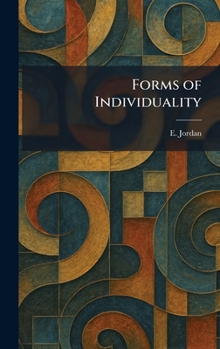
Forms of Individuality

"Forms of Individuality" is a profound exploration of social philosophy and the nature of the human subject within the framework of collective institutions. Written by the influential American philosopher E. Jordan, this work challenges traditional notions of the atomistic individual, proposing instead that individuality is fundamentally shaped by and realized through social and corporate structures. Jordan delves into the intersection of ethics, law, and politics to examine how objective institutions-such as the state, the family, and the economy-provide the necessary ground for human action and identity.
The text serves as a foundational inquiry into the concept of the corporate person, arguing that moral and legal agency are not confined to biological human beings but are shared across organized social bodies. By meticulously analyzing the relationship between the subjective self and the objective social order, "Forms of Individuality" offers a sophisticated critique of both radical individualism and abstract collectivism. This work remains a vital contribution to political theory and social ontology, providing readers with a rigorous framework for understanding the complexities of social organization and the moral significance of institutional life.
This work has been selected by scholars as being culturally important, and is part of the knowledge base of civilization as we know it. This work was reproduced from the original artifact, and remains as true to the original work as possible. Therefore, you may see the original copyright references, library stamps (as most of these works have been housed in our most important libraries around the world), and other notations in the work.
This work is in the public domain in the United States of America, and possibly other nations. Within the United States, you may freely copy and distribute this work, as no entity (individual or corporate) has a copyright on the body of the work.
As a reproduction of a historical artifact, this work may contain missing or blurred pages, poor pictures, errant marks, etc. Scholars believe, and we concur, that this work is important enough to be preserved, reproduced, and made generally available to the public. We appreciate your support of the preservation process, and thank you for being an important part of keeping this knowledge alive and relevant.
Customer Reviews
ThriftBooks ® and the ThriftBooks ® logo are registered trademarks of Thrift Books Global, LLC
