


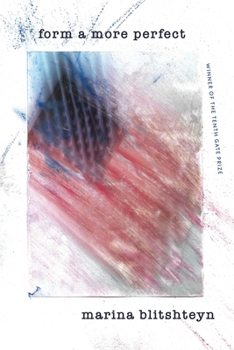
form a more perfect

Poetry. Winner of the Tenth Gate Prize. In wildly experimenting form, Marina Blitshteyn tackles identity within the boundaries of today's American frontier. From Coney Island to Buffalo to the America that hovers above us as dream-concept, through family and class and gender, she pushes to learn everything that can be discovered through language, story, and design.
Richard Hoffmans asks, "Was it always like this? What was it like back then? Why do some sit in caf s while others live on the street? What's the worst that can happen? These are questions to conjure with, and in asking them, among many others equally trenchant, the linguistically alert poems of form a more perfect conjure a vision of our common life that is emancipatory, clear, fresh, and exciting. Crossing borders of language, of class, of this or that expectation, Marina Blitshteyn's concentrated and incandescent poems are pleasurably unsettling, even liberating. Profane, vulgar, beautiful, and deeply nourishing, (blood sausages of languages/ i pick up like scraps for a dog, a bitch) the poems in form a more perfect bear witness to the tragedy of our unravelling, yet somehow manage to dance while carrying that weight."
E. C. Belli describes this work as "urgent, inscribing itself within an inheritance of Jewish diasporic works, Slavic verse, and literatures of dreamed and dystopic new worlds. It grapples with multilingualism, identity, and the way language tries until it fails and falls apart, while paradoxically offering itself up as a rare salve. In the final poems, which are redacted, a line reads: 'the poetry is for you.' In this sonically vibrant universe haunted by Moldova, where Russian, Hebrew, Yiddish, and English, as well as Buffalo, New York, and America are key players, Seussian rhymes are distorted, 'ignorance is bills, ' and the speaker is 'still a stranger' stepping into Goodwill, where 'one man's / trash is another woman's history.'"
Belli continues, "Escaping one violence to meet another, the speaker, who has been mothered and othered, uprooted and put down, labeled and misconstrued, grapples with notions of home, family, and self in a world of sobered illusions whose only firm ground, in the end, is the materiality of sound and linguistic play. Despite its serious themes and pointed critiques, Blitshteyn's voice is unshakably warm and inviting, uniting rather than divisive, shrewd and undeniable, moving seamlessly from the specifics of her distinctive world to universal considerations. This gives her verse a staying power and a rare complexity, such as that typically preoccupying literary scholars, for its unique set of circumstances. Beyond urgent, therefore, it reveals itself of great critical importance."
Related Subjects
PoetryCustomer Reviews
ThriftBooks® and the ThriftBooks® logo are registered trademarks of Thrift Books Global, LLC
