


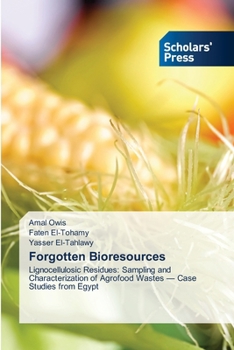
Forgotten Bioresources
No Customer Reviews

Lignocellulosic residues from agrofood wastes represent an abundant but underutilized resource for the circular economy. In Egypt and the Mediterranean region, millions of tones of date palm fronds, banana pseudo-stems, vegetable processing wastes, brewery spent grain, cotton stalks, grape and olive pruning, sugar cane bagasse, and tomato residues are burned, dumped, or left to decompose annually. This book provides a practical, standardized guide for sampling and characterizing these materials as potential feedstocks for bioplastics and other value-added products. It presents reproducible protocols for site identification, sample collection, drying, milling, and holocellulose determination, applied to eleven agrofood residues across Egypt. Each case study documents biomass source, on-site management, physical characteristics, processing metrics, and chemical composition, including holocellulose content. By establishing a common language and methodology, this guide enables researchers, engineers, and policymakers to compare results, build on each other's work, and accelerate the transition from laboratory research to industrial applications.
Format:Paperback
Language:English
ISBN:6630142292
ISBN13:9786630142297
Release Date:September 2026
Publisher:Scholars' Press
Length:64 Pages
Weight:0.22 lbs.
Dimensions:0.1" x 6.0" x 9.0"
Customer Reviews
0 rating
Copyright © 2026 Thriftbooks.com
Terms of Use | Privacy Policy | Do Not Sell/Share My Personal Information | Cookie Notice | Cookie Preferences | Accessibility Statement
ThriftBooks ® and the ThriftBooks ® logo are registered trademarks of Thrift Books Global, LLC
ThriftBooks ® and the ThriftBooks ® logo are registered trademarks of Thrift Books Global, LLC
