


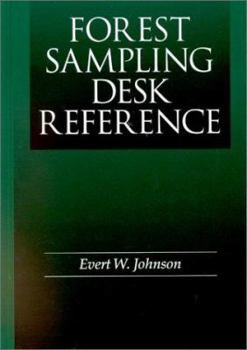
Forest Sampling Desk Reference
No Customer Reviews

Should damaged trees be clear cut and replanted or allowed to recover naturally? Is the deer herd large enough to survive hunting pressure? Managing forest resources entails numerous decisions. Making these decisions intelligently requires sound information about the resource in question. Ideally, assessments should be based on the entire population involved. However, the costs in time and money often prevent this, and evaluations - or sampling - are done on a small portion of the whole. The most complete treatment of systematic sampling in one volume, Forest Sampling Desk Reference explains the uses and limitations of individual sampling designs in forest inventory operations. This text contains detailed derivations of the most commonly used statistical methods in forestry. It provides examples that highlight the statistical methods. The author covers probability and probability distributions and the development of logical regression models. The text discusses systematic sampling, describing its benefits and shortcomings in detail. It provides an in depth examination of the controversial 3-P sampling procedure. The validity and strength of sampling results vary from option to option, along with their costs in terms of money and time. Before selecting a sampling procedure you need to know their strengths and weaknesses in relation to their expense. Forest Sampling Desk Reference supplies the background necessary for making these decisions.
Format:Hardcover
Language:English
ISBN:0849300584
ISBN13:9780849300585
Release Date:June 2000
Publisher:CRC Press
Length:1008 Pages
Weight:4.11 lbs.
Dimensions:10.0" x 2.0" x 7.0"
Customer Reviews
0 rating
Copyright © 2026 Thriftbooks.com Terms of Use
| Privacy Policy | Do Not
Sell/Share My Personal Information | Cookie Policy | Cookie Preferences | Accessibility Statement
ThriftBooks® and the ThriftBooks® logo are registered trademarks of Thrift Books Global, LLC
ThriftBooks® and the ThriftBooks® logo are registered trademarks of Thrift Books Global, LLC
