


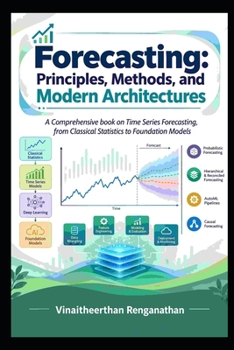
Forecasting: Principles, Methods, and Modern Architectures: A Comprehensive book on Time Series Forecasting, from Classical Statistics to Foundation M
No Customer Reviews

Forecasting models helps us to take informed decision from the historical data. Business organizations decide how much stock to hold, utilities decide how much generating capacity to schedule, hospitals decide how many staff to recruit, and financial institutions decide how much risk to carry, all on the basis of statements about a future that has not yet happened. Over the past years the methods available for making those statements have expanded dramatically, from the exponential smoothing and ARIMA models that have served practitioners for more than half a century to deep neural networks, transformer architectures, and pretrained foundation models. This book provides an overview of these models. The book is helpful for students in statistics, data science, economics, operations research, and engineering, and for practitioners who build and maintain forecasting systems in industry. It assumes a working knowledge of introductory statistics and linear algebra and basic fluency in Python. No prior exposure to time series analysis is required: the early chapters develop the vocabulary, the data preparation techniques, and the statistical foundations on which the later material depends. The book includes eleven chapters. Chapters 1 to 3 establish the foundations: the nature of time series data and the forecasting process, the cleaning and feature engineering that precede modeling, and the concepts of stationarity, autocorrelation, and decomposition. Chapters 4 and 5 present the classical toolkit, namely baseline methods and exponential smoothing, followed by the ARIMA family and its seasonal and regression extensions. Chapters 6 and 7 turn to modern machine learning, first through hybrid architectures that combine econometric and neural components, and then through foundation models capable of zero-shot and few-shot forecasting. Chapters 8 to 11 address the problems that arise when forecasts are used in real decisions: quantifying uncertainty, keeping forecasts coherent across hierarchies, automating model selection and monitoring at scale, and moving from prediction to causal reasoning about interventions. Each chapter combines conceptual explanation with practical material. Case studies drawn from retail, energy, finance, healthcare, and supply chain management show how the methods are applied, and Python implementations, built mainly on NumPy, pandas, and statsmodels, with PyTorch for the neural architectures, make the ideas concrete. The code is intended to be read, run, and adapted rather than used as production software, and readers should check library versions and documentation before reusing it. At the end of each chapter, review questions test conceptual understanding, exercises encourage hands-on practice, and a reference list directs readers to the primary literature for further study. The book can be read from beginning to end, and doing so is recommended for readers new to the field. Instructors designing a one-semester course may find that Chapters 1 to 5 together with a selection from Chapters 8 to 10 form a complete introduction, with Chapters 6, 7, and 11 serving as advanced topics. Readers with prior experience in time series analysis can move directly to the chapters that interest them, consulting earlier chapters for definitions and notation as needed. Forecasting is a rapidly moving field, and the chapters on foundation models and automated pipelines in particular describe areas that are changing from year to year. The reference lists are intended as starting points rather than final authorities, and readers are encouraged to follow the current literature. The enduring principles, however, change slowly: understand the data, respect the temporal structure, compare against honest baselines, quantify uncertainty, and keep the decision that the forecast supports firmly in view.
Format:Paperback
Language:English
ISBN:B0HNP9KTTM
ISBN13:9798163921775
Release Date:October 2026
Publisher:Independently Published
Length:210 Pages
Weight:0.63 lbs.
Dimensions:0.4" x 6.0" x 9.0"
Customer Reviews
0 rating
Copyright © 2026 Thriftbooks.com
Terms of Use | Privacy Policy | Do Not Sell/Share My Personal Information | Cookie Notice | Cookie Preferences | Accessibility Statement
ThriftBooks ® and the ThriftBooks ® logo are registered trademarks of Thrift Books Global, LLC
ThriftBooks ® and the ThriftBooks ® logo are registered trademarks of Thrift Books Global, LLC
