


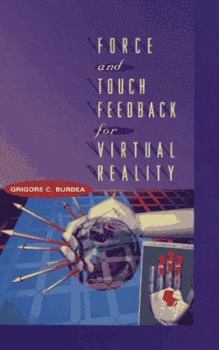
Force and Touch Feedback for Virtual Reality

A comprehensive treatment of force feedback--the hottest area of research in virtual reality Can interactivity in virtual reality (VR) extend to include our sense of touch? Could weight, temperature, and texture combine to bring simulated objects to life? Describing cutting-edge technology that will influence the way we interact with computers for years to come, this pioneering book answers yes: not only is it possible, but devices capable of providing force and tactile sensory feedback already exist. Force and Touch Feedback for Virtual Reality is the first comprehensive source of information on the design, modeling, and applications of force and tactile interfaces for VR. It is a must have for scientists, engineers, psychologists, and developers involved in VR, and for anyone who would like to gain a deeper understanding of this exciting and fast-growing field. Complete with hundreds of tables, figures, and color illustrations, Force and Touch Feedback for Virtual Reality offers Basic information on human tactile sensing and control and feedback actuator technology A worldwide survey of force and tactile interface devices, from the simple joystick to full-body instrumented suits based on human factor tests Step-by-step instructions for realistic physical modeling of virtual object characteristics such as weight, surface smoothness, compliance, and temperature A unified treatment of the benefits of the new haptic interface technology for simulation and training based on human factor tests A detailed analysis of optimum control requirements for force and tactile feedback devices A review of emerging applications in areas ranging from surgical training and entertainment to telerobotics and the military
Format:Hardcover
Language:English
ISBN:0471021415
ISBN13:9780471021414
Release Date:August 1996
Publisher:Wiley-Interscience
Length:368 Pages
Weight:1.60 lbs.
Dimensions:9.5" x 0.8" x 6.3"
Customer Reviews
2 ratings
Feeling Virtual Worlds
Published by Thriftbooks.com User , 24 years ago
One of the most common complaints about virtual world experiences is that the lack of physical sensations in the environment. Visual simulation is nearing photographic quality, and 3D sound is very convincing. But as soon as one touches a virtual object, or picks up a virtual car and tosses it into the next simulation, one has a great sense of incompleteness. "Why", the question is often asked, "can't I feel anything in this great virtual reality?"There is no easy answer to that question, despite the millions ofdollars and thousands of hours spent trying to understand andduplicate our incredibly subtle and complex haptic senses. However, at last, we can at least understand the magnitude of the problem, and the state of the art. Grigore Burdea, an Associate Professor at the CAIP Center of Rutgers University, spent most of last year engaged in research and writing about this missing dimension of VR. His new book, Force and Touch Feedback for Virtual Reality, is the result of that effort. As far as I know, there is no more complete or erudite book on the subject.Burdea careful lays the groundwork for his survey of force feedback (resistive impulses, FFB) and tactile feedback (sensations of texture, temperature, etc., TFB) devices and concepts by providing a thorough background in human proprioception. He shares with the reader the fruits of his research: how the various receptors in the skin, muscles, bones and joints interact, how the nervous system perceives and conveys haptic data, reaction times and bandwidths of human response, and much more. He describes studies on the resolution of feeling, the average strength of various parts of the body, and time to fatigue. All in all, one is left with the impression thatBurdea is a man with a good feel for the subject.Interestingly, reading this book made me all the more pessimisticregarding our likelihood of ever having good FFB devices for general use. The problem is manifold. As Burdea points out, the range of forces that human beings are capable of feeling and reacting to is great. It spans several orders of magnitude, from the gentle caress of a lover brushing away a strand of hair, to the rough effort required to push a recalcitrant automobile. Designing one device, even a hybrid device, to duplicate this range of force is a daunting concept. Furthermore, FFB devices must be grounded. That is, they must have something to push against. A portable FFB device would necessarily be of limited scope.The outlook for TFB devices is much better. Because these devices are not resistive in nature, they can (indeed, should be) small and portable. A glove with an inner surface made of nano-mechanical effectors is conceivable, and could possibly provide realisticsensations of friction, slippage, texture, and other sensations. However, the likelihood of such a device being built in the next few years is slim.Lacking any ideal solution, many experimenters and manufacturers,Burdea among them, have developed limited
A reference book for VR haptic technology
Published by Thriftbooks.com User , 25 years ago
This a great textbook on this new human-computer interface technology. The book is destined to become a classic of this field due to its in-depth, comprehensive treatment of the haptic technology. It was no suprise to me to see it is cited in many technical articles. The book present not only technical data (actuators, force and touch feedback devices) but also the basic information related to human haptic sensing. In addition, the book complete its review of haptic systems with a chapter on human factors, which contains a collection of interesting experiments attesting the potential of this new technology. Unfortunately haptics is still in its infancy which makes it difficult to speculate on its future (as concluded in the last chapter).In short the book will give you a good understanding of this new technology, being also a very good reference compendium.
Copyright © 2026 Thriftbooks.com Terms of Use
| Privacy Policy | Do Not
Sell/Share My Personal Information | Cookie Policy | Cookie Preferences | Accessibility Statement
ThriftBooks® and the ThriftBooks® logo are registered trademarks of Thrift Books Global, LLC
ThriftBooks® and the ThriftBooks® logo are registered trademarks of Thrift Books Global, LLC
