


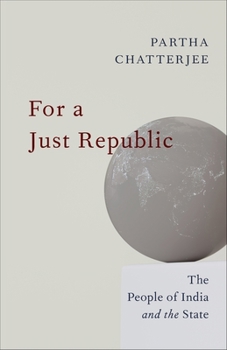
For a Just Republic: The People of India and the State
No Customer Reviews

Select Format
Select Condition 
Book Overview
From the forging of a constitution for the postindependence republic to the reign of Narendra Modi's Bharatiya Janata Party today, the idea of India as a nation-state has predominated. Yet the country encompasses a vast diversity of communities, regions, languages, and cultures, calling into question any unitary identity.
In this magisterial account of Indian politics over the past seventy-five years, the renowned scholar Partha Chatterjee challenges common notions of "state" and "nation," arguing for a more capacious understanding of "the people." He examines the varying trajectories of the Indian nation-state, as opposed to what he calls the "people-nation," analyzing the complex connections between the two. Chatterjee offers a persuasive political-economic analysis of the transition from the time of developmental planning to the present era of capitalist dominance. He combines keen analysis of changing caste-class-gender formations in the country's diverse regions with a close examination of the uneven spread of India's capitalist economy. By looking beyond the nation-state, this book unveils many hidden aspects of Indian politics today--and makes a powerful case for a future in which the federal system respects the equal worth of each part of the country.Format:Paperback
Language:English
ISBN:0231224281
ISBN13:9780231224284
Release Date:January 1
Publisher:Columbia University Press
Length:496 Pages
Customer Reviews
0 rating
Copyright © 2026 Thriftbooks.com Terms of Use
| Privacy Policy | Do Not
Sell/Share My Personal Information | Cookie Policy | Cookie Preferences | Accessibility Statement
ThriftBooks® and the ThriftBooks® logo are registered trademarks of Thrift Books Global, LLC
ThriftBooks® and the ThriftBooks® logo are registered trademarks of Thrift Books Global, LLC
