


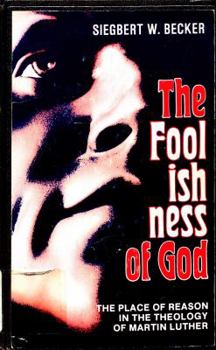
The Foolishness of God: The Place of Reason in the Theology of Martin Luther


The NPH Classics series consists of popular titles published by Northwestern Publishing House throughout its history. Each title has been reprinted for our Classics series and reflects the works that... This description may be from another edition of this product.
Format:Paperback
Language:English
ISBN:0810001551
ISBN13:9780810001558
Release Date:January 1982
Publisher:Northwestern Publishing House
Length:266 Pages
Weight:0.66 lbs.
Customer Reviews
5 ratings
Great!
Published by Thriftbooks.com User , 20 years ago
This book is a wonderful piece of literature written to the glory of God on a topic that is soooo important for Christianity, particularly Lutheranism. Very well-written and recommended for anyone!
Read this and understand what makes Lutheranism tick
Published by Thriftbooks.com User , 21 years ago
This book is one of my favorites. I recommend it to many people that I talk theology with, and has shaped my thought significantly. Becker, in this book, studies Martin Luther's thoughts on Reason and it's relationship to Faith. In the process, you learn how Martin Luther went through his mental machinations and came to conclusions. This book is not for the faint of heart. It's kinda philosophical. But Luther is humorous, and to the point. Lutherans approach theology in a different way than most Christians do today, and this book chronicles why, points out their presuppostions, and how Lutherans approach God inductively through what Scripture teaches about Himself. Becker's final chapter does a good job at summing up why Lutherans answer debated Christian doctrines like "the Incarnation" and "Predestination/Free Will" differently than most Christian denominations. Read this book to understand how confessional Lutheran thought ticks, their presuppositions, and be challenged. If you are a theologian (armchair or professional), read this book and learn how to bust theological moves like Luther did.
Vital Apologetical Understanding of Reason
Published by Thriftbooks.com User , 21 years ago
Becker provided a vital and interesting investigation into Luther's concept of reason. What is so useful is finding out about Luther's use of reason as magesterial vs. ministerial. Being educated and catechized in the medieval theology Luther knew the center as Reason around philosophy, which still dominates RC theology (see Ratzinger's "Principles of Catholic Theology). Many misinterpret and thus misuse and abuse Luther and his theological offspring by taking him out of context concerning Reason and Christianity. Becker's book is antidote to this.
A book that shows the place of reason in Lutheran theology
Published by Thriftbooks.com User , 24 years ago
Siegbert W. Becker's "The Foolishness of God" is an absolutely astounding book from start to finish. Becker gives insight into almost every aspect of Lutheran theology. From the bodily presence of Christ in the Eucharist to the paradoxical nature of the bondage of the Will. As I'll point out, Becker delves into the realms of these concepts and never seems to forget to include how they fit with his whole theme of reason.Thomism: Becker uses Luther's rejection of Thomism (the theology of Thomas Aquinas for anyone who may not know) in order to support his thesis on reason. Becker says of Luther, "[he] consistently held instead that natural theology is always uncertain, inadequate, misleading, and legalistic" (page 50.) Luther outright says that those who try to explain the existence of God with reason and without the Word err greatly. Becker makes perfect sense out of Luther's rejection of Thomism. This chapter can be summed up with this quote of Luther's: "So reason must make idols and it cannot do otherwise."On Biblical Truth: One of the more intriguing chapters of the book, is Chaper IV, "Reason as Judge of Biblical Truth." In it, Becker attempts to explain the Lutheran position on Biblical inspiration and belief, in the light of reason. Although it's quite interesting to hear his take on biblical inspiration, the following page presents one of the more interesting quotes of the book: "Luther was convinced that the better a person understands the Word of God the harder it is for him to believe it" (page 94.) This quote presents one of the more challenging aspects to tackle in the entire book. However, Becker only deals with this about half as well as he probably could have. However, he still presents an intriguing idea. He suggests that Luther did not mean "reason" as we know it, but rather the German word Vernunft, which means "common sense." This seems to be a fair enough explanation for Becker, because he just continues along with his theme.The Eucharist (Holy Communion): Yet another interesting aspect of the book is Becker's take on the Lutheran doctrine of the Eucharist in the light of reason. Luther says that reason can tell us that the Bread is merely Bread and the Wine is merely Wine, however, reason knows that the Word of God defies all understanding. Reason, Luther would have probably said, would be the reason why so many churches today (even so-called "Lutheran" churches) teach the idea of "open communion" and the representation in the Sacrament. They teach that the bread is merely bread, and that the wine is merely wine, for how can it be both the bread and the body and the blood and the wine. And how can Christ be at the right hand of God and in the sacrament at the same time? Luther taught that it was this kind of doctrine that got man in trouble. When the Christian begins to rely more on reason then on the Word and faith. Becker provides some really interesting insight on this and it's yet another reason to pick up this book.The Bo
Reason must be made Christian
Published by Thriftbooks.com User , 25 years ago
What a splendid book! Originally, this book started as Becker's doctoral thesis in 1957, but was, eventually, expanded into a book. Thus, a couple of examples in the book are outdated-but the rest of the book is timeless. Becker's primary point of the book is that our reason is contrary to God's way of doing things. "To make the gospel reasonable to unconverted man in an effort to bring about his acceptance of that gospel is therefore the height of folly. Such efforts can only result in a change in the gospel, consequently a destruction of the gospel." (Pg. 230)Becker no only delves into Luther's thoughts on human reason, but also how Scripture seems to contradict. For instance, the Bible mentions in many places that "once saved, always saved" as some like to say. Yet Scripture also says, "take heed, lest you fall." Both are correct and true--yet how are we to reconcile these seeming different doctrines? Part of this is understanding the Law-Gospel dynamic, which Becker probes into as well.This is one book to reread every few years like C.F.W. Walther's The Proper Distinction between Law and Gospel. May it find its way onto every Christian's bookshelf.
Copyright © 2026 Thriftbooks.com Terms of Use
| Privacy Policy | Do Not
Sell/Share My Personal Information | Cookie Policy | Cookie Preferences | Accessibility Statement
ThriftBooks® and the ThriftBooks® logo are registered trademarks of Thrift Books Global, LLC
ThriftBooks® and the ThriftBooks® logo are registered trademarks of Thrift Books Global, LLC
