


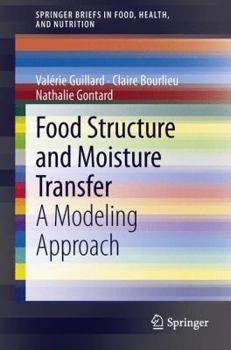
Food Structure and Moisture Transfer: A Modeling Approach
No Customer Reviews

It's well known that the structural characteristics of food materials influence their mass transfer, especially their water transfer properties during such processes as drying, hydration, and storage. In porous cereal-based products, for example, effective water diffusivity is highly affected by the volume fraction and distribution of both solid and gas phases, while in dense food materials, such as fat-based or other edible coatings, it depends on factors that affect the "tightness" of the molecular structure (e.g., free volume, cohesive energy density, crystallinity). This Brief will review the impact of food structure on moisture transfer. A multi-scale analysis of food structure will include a look at molecular structure (e.g., free volume, crystallinity), nanostructure, microstructure (e.g., porous food), and macrostructure (e.g., bilayer structure). For each structural analysis, a focus on the mathematical modelling of the relationship between structural properties and moisture transfer properties will be performed.
Format:Paperback
Language:English
ISBN:1461463416
ISBN13:9781461463412
Release Date:February 2013
Publisher:Springer
Length:60 Pages
Weight:0.45 lbs.
Dimensions:0.2" x 6.1" x 9.0"
Related Subjects
Engineering Science Science & Math Science & Scientists Science & Technology TechnologyCustomer Reviews
0 rating
Copyright © 2026 Thriftbooks.com
Terms of Use | Privacy Policy | Do Not Sell/Share My Personal Information | Cookie Policy | Cookie Preferences | Accessibility Statement
ThriftBooks ® and the ThriftBooks ® logo are registered trademarks of Thrift Books Global, LLC
ThriftBooks ® and the ThriftBooks ® logo are registered trademarks of Thrift Books Global, LLC
