


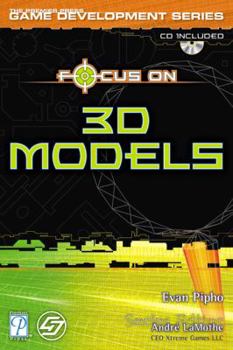
Focus On 3D Models (Game Development)


Select Format
Select Condition 
Book Overview
The book is a reference for developers using 3D models. Instead of simply showing a spec sheet, the book delves into the loading and rendering techniques of 3D models. The text is as API and platform... This description may be from another edition of this product.
Format:Paperback
Language:English
ISBN:1592000339
ISBN13:9781592000333
Release Date:December 2002
Publisher:Cengage Learning PTR
Length:200 Pages
Weight:0.73 lbs.
Dimensions:8.8" x 0.5" x 6.0"
Customer Reviews
5 ratings
Not great, not awful
Published by Thriftbooks.com User , 18 years ago
While the model formats discussed are the more popular ones, there are quite a few details that were omitted in the book about them. On the other side of the coin, there aren't many books specifically for model formats. All the information that is missing, is easy enough to find with a little research.
Small, short and to the point
Published by Thriftbooks.com User , 20 years ago
Explains some of the more common 3d models and includes an appendix with links about other formats not covered. This book only briefly explains some technologies, like skeletal modeling, and otherwise just tells you what you need to get them rendered. Just enough to get you started.
Good beginners intro
Published by Thriftbooks.com User , 22 years ago
An excellent starting point for somebody that knows nothing at all about 3D models, but can only be considered a stepping stone to other books that gloss over the basics.He starts with a good intro to matrices and quaternions, followed by a good intro to modeling concepts, and then describes a few formats in detail. Unfortunately, he doesn't go into any more advanced discussion on how to put things together... i.e. how to *use* the models. A few pages are wasted explaining how to use some basic "C", but I've seen worse...Overall, I give it four stars because, if you know nothing of the topic, it is an excellent jump start. If you do have knowledge of the topic, then you aren't the target audience.
Fulfills its stated purpose well
Published by Thriftbooks.com User , 22 years ago
This book covers the loading and handling of 3D models from the programmer's point of view (not the artist's, which may not be immediately obvious from the title). Like other Focus On books, it's short (checking in at just under 200 pages), but doesn't spend a lot of time on introductory material or subjects not related to the main topic.The model formats covered by this book are Quake 2 (.md2), .obj, MilkShape, 3D Studio Max (.3ds), Half-life (.mdl), and Quake 3 (.md3). All of these formats are covered quite well, with sample code showing how to load, display and (when applicable) animate them. The exception is the Half-life format, for which he just uses the SDK, so there's no real information on the format itself. In addition to the specific formats, there are chapters on skeletal animation and useful tips on working with models.My only real complaint is that about 1/4 of the book's pages are spent on covering vectors, matrices, quaternions, and STL vectors. Although knowledge of these topics is important for understanding the rest of the book, I'd suspect most readers will already be familiar with them. I would have preferred to have these chapters included on the CD instead, freeing up space for more useful information (detailed coverage of the Half-life format, perhaps?).Overall, though, I was happy with the book. It's compact, inexpensive, an easy read, and it's nice to have the most common formats covered in one convenient volume. If you're looking for an introduction to using 3D models, or just want a physical reference for these formats to keep on your desk, I'd recommend it.
Good as a reference
Published by Thriftbooks.com User , 23 years ago
Although all of the information in this book is available for free on various sites online, it's worth the small price to have it all in one bound hardcopy.A few chapters go over the basics of matrix and vector math, and the concepts behind animating models: not essential stuff for what is essentially a model format reference book.The core of the book describes in detail the following formats: Quake2 (MD2), Maya (OBJ), Autodesk (3DS), Half-Life (MDL) and Quake3 (MD3). All the formats except Half-Life MDL's are described in detail. The author really dropped the ball in the "Half-Life MDL" chapter: Instead of describing the format from scratch, he just tells you to use the Half-Life SDK, because "the Half-Life format is very, very complex."One minor nit-pick: There is no mention that 16-bit and 32-bit data in binary formats are stored in little-endian format, and must be byte swapped on non-Intel machines.Even with all this criticism, I rate the book 4 stars, because overall I am happy with the level of detail presented in the file format chapters.
Copyright © 2026 Thriftbooks.com Terms of Use
| Privacy Policy | Do Not
Sell/Share My Personal Information | Cookie Policy | Cookie Preferences | Accessibility Statement
ThriftBooks® and the ThriftBooks® logo are registered trademarks of Thrift Books Global, LLC
ThriftBooks® and the ThriftBooks® logo are registered trademarks of Thrift Books Global, LLC
