


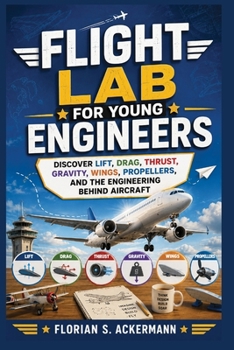
Flight Lab for Young Engineers: Discover Lift, Drag, Thrust, Gravity, Wings, Propellers, and the Engineering Behind Aircraft

Discover Lift, Drag, Thrust, Gravity, Wings, Propellers, and the Engineering Behind Aircraft
How does an airplane stay in the air? Why do wings have a particular shape? What makes an aircraft move forward, and how do engineers design machines that can fly?
Flight Lab for Young Engineers introduces young readers to the science and engineering principles behind aircraft and flight. Through clear explanations and practical learning concepts, the book explores how forces, aircraft components, and engineering decisions work together to make flight possible.
The book provides an accessible introduction to the fundamental ideas that help explain how airplanes and other flying machines operate.
Inside the book, young learners explore:
The basic science of flightLift and how wings interact with moving airDrag and its effect on aircraft motionThrust and how aircraft move forwardGravity and its influence on flightWings and basic aerodynamic principlesPropellers and their role in producing thrustAircraft structures and major componentsThe relationship between speed, force, and motionHow engineers think about aircraft designBasic principles of stability and controlFlight experiments and engineering observationsConnections between physics, mathematics, and aerospace engineeringFlight begins with forces. An aircraft must generate enough lift to support its weight while producing sufficient thrust to overcome drag. Understanding how these forces interact provides a foundation for understanding aircraft motion.
Wings play an important role in producing lift. Their shape and interaction with moving air affect the forces acting on an aircraft. The book introduces these concepts in an accessible way, helping young readers connect scientific ideas with the physical design of an airplane.
Thrust is another important part of flight. Aircraft can use different propulsion systems to produce forward motion. Propellers, for example, transfer energy into the surrounding air and help produce thrust.
Gravity continuously acts on an aircraft, pulling it toward Earth. Engineers must consider gravity along with lift, thrust, and drag when designing and analyzing flying machines.
The book also introduces the engineering process behind aircraft design. Engineers consider materials, shape, weight, propulsion, stability, control, efficiency, and operating conditions when developing aircraft.
Young readers can explore flight by observing simple examples, asking questions, comparing designs, and thinking about how changes to an aircraft might affect its behavior. These activities can help connect classroom science with real engineering problems.
Flight Lab for Young Engineers is designed for curious learners who want to understand how airplanes fly and how engineers use science and mathematics to develop aircraft.
From lift and drag to wings, propellers, thrust, and gravity, this book provides an introduction to the physical principles and engineering ideas behind flight.
Explore the forces. Understand the design. Discover the science behind flight.
Customer Reviews
ThriftBooks ® and the ThriftBooks ® logo are registered trademarks of Thrift Books Global, LLC
