


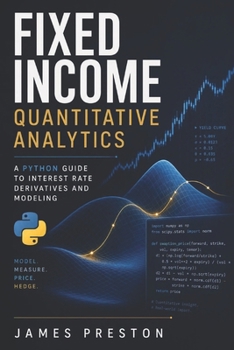
Fixed Income Quantitative Analytics: A Python Guide to Interest Rate Derivatives and Modeling

Bridge the gap between financial theory and quantitative execution with this practical guide to fixed-income modeling using Python.
Modern fixed-income markets demand a rigorous approach to valuation, risk management, and derivative pricing. Fixed Income Quantitative Analytics provides a comprehensive framework for software architects, data scientists, and financial engineers looking to build robust, production-ready valuation engines from scratch.
This book strips away the mathematical abstraction to deliver clear, step-by-step implementations of core quantitative concepts. By combining advanced financial engineering principles with clean, object-oriented Python code, you will learn how to design flexible architecture capable of handling complex market data and volatile rate environments.
Inside, you will explore the core pillars of fixed-income engineering:
Foundations of Analytics: Master the mechanics of bootstrapping yield curves, constructing discount factors, and handling day-count conventions with precision.
Term Structure Modeling: Implement and calibrate industry-standard frameworks, including the Vasicek, Cox-Ingersoll-Ross (CIR), and Hull-White models.
Interest Rate Derivatives: Code pricing engines for vanilla instruments, swaps, swaptions, caps, and floors using both analytical formulas and numerical methods.
Numerical Methods and Simulation: Deploy Monte Carlo simulations and finite difference methods to price path-dependent structures and measure risk sensitivities (the Greeks).
Whether you are looking to refine your quantitative development skills or transition traditional financial models into scalable code, this book serves as an engineering blueprint for modern interest rate analytics.
Customer Reviews
ThriftBooks ® and the ThriftBooks ® logo are registered trademarks of Thrift Books Global, LLC
