


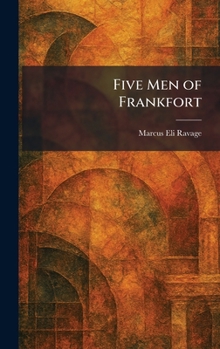
Five Men of Frankfort

"Five Men of Frankfort" is a compelling biographical account of the rise of the Rothschild dynasty, one of the most influential families in modern financial history. Written by Marcus Eli Ravage, the work traces the extraordinary journey of the five sons of Mayer Amschel Rothschild as they expanded their father's banking empire from the Judengasse of Frankfurt to the major capitals of Europe: London, Paris, Vienna, and Naples.
The narrative explores how these five brothers navigated the turbulent political landscape of the Napoleonic era and the Industrial Revolution to establish an unprecedented international financial network. Through meticulous detail, Ravage examines the family's unity, their innovative banking strategies, and their significant impact on European diplomacy and warfare. This historical study offers more than just a family history; it provides a window into the evolution of global finance and the intersection of wealth and power during the nineteenth century. "Five Men of Frankfort" remains a definitive look at how a single family shaped the economic foundations of the modern world.
This work has been selected by scholars as being culturally important, and is part of the knowledge base of civilization as we know it. This work was reproduced from the original artifact, and remains as true to the original work as possible. Therefore, you may see the original copyright references, library stamps (as most of these works have been housed in our most important libraries around the world), and other notations in the work.
This work is in the public domain in the United States of America, and possibly other nations. Within the United States, you may freely copy and distribute this work, as no entity (individual or corporate) has a copyright on the body of the work.
As a reproduction of a historical artifact, this work may contain missing or blurred pages, poor pictures, errant marks, etc. Scholars believe, and we concur, that this work is important enough to be preserved, reproduced, and made generally available to the public. We appreciate your support of the preservation process, and thank you for being an important part of keeping this knowledge alive and relevant.
Customer Reviews
ThriftBooks ® and the ThriftBooks ® logo are registered trademarks of Thrift Books Global, LLC
