


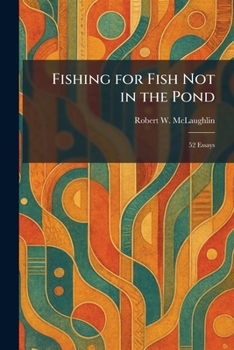
Fishing for Fish Not in the Pond: 52 Essays

"Fishing for Fish Not in the Pond: 52 Essays" is a thought-provoking collection of weekly reflections that delve into the complexities of human existence and the pursuit of meaning. Written by Robert W. McLaughlin, these essays offer a unique perspective on ethics, philosophy, and the spiritual dimensions of daily life. The title metaphorically suggests a search for truth and value in places others might overlook, inviting readers to explore ideas beyond the superficial surface of society.
Each of the fifty-two entries serves as a standalone meditation, making the work an ideal companion for a year of contemplative reading. McLaughlin's prose captures the intellectual and moral concerns of the early 20th century, providing insight into the timeless questions that continue to resonate today. Whether discussing individual character, social responsibility, or the quiet observations of nature and humanity, this work stands as a testament to the enduring power of the personal essay as a tool for self-discovery and cultural critique. Readers interested in literary non-fiction and philosophical inquiry will find "Fishing for Fish Not in the Pond: 52 Essays" to be a rich and rewarding exploration of the unseen currents that shape our lives.
This work has been selected by scholars as being culturally important, and is part of the knowledge base of civilization as we know it. This work was reproduced from the original artifact, and remains as true to the original work as possible. Therefore, you may see the original copyright references, library stamps (as most of these works have been housed in our most important libraries around the world), and other notations in the work.
This work is in the public domain in the United States of America, and possibly other nations. Within the United States, you may freely copy and distribute this work, as no entity (individual or corporate) has a copyright on the body of the work.
As a reproduction of a historical artifact, this work may contain missing or blurred pages, poor pictures, errant marks, etc. Scholars believe, and we concur, that this work is important enough to be preserved, reproduced, and made generally available to the public. We appreciate your support of the preservation process, and thank you for being an important part of keeping this knowledge alive and relevant.
Customer Reviews
ThriftBooks ® and the ThriftBooks ® logo are registered trademarks of Thrift Books Global, LLC
