


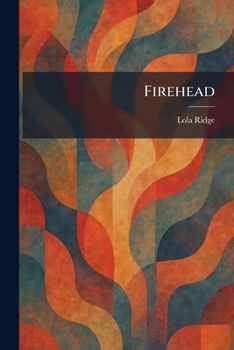
Firehead

Select Format
Select Condition 
Book Overview
"Firehead" is an intense and sweeping narrative poem that reimagines the day of the Crucifixion of Christ through a modernist lens. Written by the acclaimed poet Lola Ridge, the work departs from traditional religious tropes to offer a visceral, multi-perspective exploration of the Passion. The poem provides deep psychological insights into the figures surrounding the event, including Mary, Judas, Peter, and the Magdalene, weaving their internal experiences into a larger cosmic drama.
Characterized by its stark imagery and rhythmic urgency, "Firehead" captures the emotional and physical reality of suffering and transcendence. Ridge utilizes her distinctive voice to blend social consciousness with spiritual inquiry, presenting the historical event as a moment of profound human significance. This ambitious work stands as a testament to the power of narrative verse, offering a transformative reading experience that explores the intersections of divinity, humanity, and sacrifice. It remains an essential piece of 20th-century American literature for its formal innovation and its searing, empathetic portrayal of a foundational cultural narrative.
This work has been selected by scholars as being culturally important, and is part of the knowledge base of civilization as we know it. This work was reproduced from the original artifact, and remains as true to the original work as possible. Therefore, you may see the original copyright references, library stamps (as most of these works have been housed in our most important libraries around the world), and other notations in the work.
This work is in the public domain in the United States of America, and possibly other nations. Within the United States, you may freely copy and distribute this work, as no entity (individual or corporate) has a copyright on the body of the work.
As a reproduction of a historical artifact, this work may contain missing or blurred pages, poor pictures, errant marks, etc. Scholars believe, and we concur, that this work is important enough to be preserved, reproduced, and made generally available to the public. We appreciate your support of the preservation process, and thank you for being an important part of keeping this knowledge alive and relevant.
Customer Reviews
ThriftBooks ® and the ThriftBooks ® logo are registered trademarks of Thrift Books Global, LLC
