


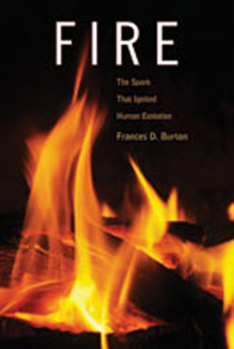
Fire: The Spark That Ignited Human Evolution


Select Format
Select Condition 
Book Overview
The association between our ancestors and fire, somewhere around six to four million years ago, had a tremendous impact on human evolution, transforming our earliest human ancestor, a being communicating without speech but with insight, reason, manual dexterity, highly developed social organization, and the capability of experimenting with this new technology. As it first associated with and then began to tame fire, this extraordinary being began to distance itself from its primate relatives, taking a path that would alter its environment, physiology, and self-image. Based on her extensive research with nonhuman primates, anthropologist Frances Burton details the stages of the conquest of fire and the systems it affected. Her study examines the natural occurrence of fire and describes the effects light has on human physiology. She constructs possible variations of our earliest human ancestor and its way of life, utilizing archaeological and anthropological evidence of the earliest human-controlled fires to explore the profound physical and biological impacts fire had on human evolution.
Format:Hardcover
Language:English
ISBN:0826346464
ISBN13:9780826346469
Release Date:April 2009
Publisher:Unm Press
Length:248 Pages
Weight:1.28 lbs.
Dimensions:0.9" x 6.3" x 9.2"
Customer Reviews
3 ratings
Prometheus' legacy
Published by Thriftbooks.com User , 16 years ago
According to Greek mythology Prometheus stole fire from the Gods and gave it to man. For this service, Zeus punished Prometheus with the dubious gift of foresight. Just like the Greek myth this excellent work by anthropologist Frances Burton makes the point that the dubious gift of fire was not without its consequences in terms of human evolution and indeed may have been the very force to actually spur the evolutionary forces that made humans acquire their particular qualities. (NOTE: Where this review uses the term "human" it means to include all hominid ancestors as well as contemporary living humans, their descendants.) Starting at the beginning, Burton goes back six million years to when humans broke off from chimpanzees and bonoboos. She noted that even today chimpanzees and bonoboos do not show a fear of fire when insects are accidentally caught in it. The chimpanzees and bonoboos know that by quickly reaching between the flames they can snag a good treat. In an interesting aside on this very point, Burton favorably compares certain insects with more traditional fare to show how they actually provide more nutrition (a fact admittedly that still does little to inspire me to eat insects but still has interesting evolutionary consequences). Building from the accidental to the more purposeful Burton posits an evolutionary theory wherein our ancestors came to purposefully capture fire and then to create it. Unlike the popular movie Quest for Fire, this process according to Burton doesn't recess tens of thousands of years into history but rather millions of years into history. I really like this book for a variety of reasons: Firstly, like Bickerton's Language and Species, this book shows the natural evolution of a human trait from behaviors that naturally would have occured among our ancestors and therefore follows the Darwinian dictate that human behaviors are different only in quality rather than in their inherent nature. Secondly, this book dovetails neatly with that other prominent 2009 release on fire Cooking with Fire which discusses the ways in which nutritionally cooked food came to alter human brain power (viz: more readily produceable nutritious meals enabled humans to apply their intellectual skills to things other than mere survival...the very definition of "brain food"). Thirdly, this book boldly suggests that the control of fire enabled humans to control their environment and litterally conquer night. In that way, one can come to see the human control of fire as a first step that would ultimately lead to human occupation of all terrestrial environments and even forays into space itself.
well worth it
Published by Thriftbooks.com User , 17 years ago
This is a hard slog. The book is very ambitious. The author is frank in that on some important points, her point of view is just that and it disagrees often enough with Wrangham's new book on this topic. The book is very rich, bringing in the latest research in fields that have (it would seem) just been christened. The thoroughness and the persistence pay off; the book is a real intellectual tour-de-force and a rewarding read.
The story of fire, and as such, the story of mankind
Published by Thriftbooks.com User , 17 years ago
Fire is truly the one thing that separates man from beast. "Fire: The Spark That Ignited Human Evolution" traces the history of fire through ancient times to the modern age. If man never gained control of fire, humanity would have never become the technologically advanced species we are today, but may in fact have died out tens of thousands of years ago. Fire is truly a fascinating thing, and author Frances Burton does well in connecting human evolution to fire. "Fire" is the story of fire, and as such, is the story of mankind.
Copyright © 2026 Thriftbooks.com
Terms of Use | Privacy Policy | Do Not Sell/Share My Personal Information | Cookie Policy | Cookie Preferences | Accessibility Statement
ThriftBooks ® and the ThriftBooks ® logo are registered trademarks of Thrift Books Global, LLC
ThriftBooks ® and the ThriftBooks ® logo are registered trademarks of Thrift Books Global, LLC
