


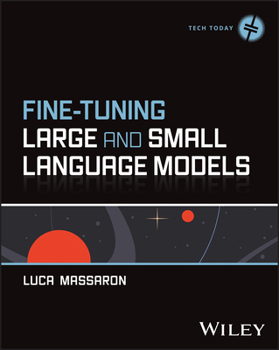
Fine-Tuning Large and Small Language Models

Fine-tune open-source language models with LoRA, QLoRA, and Hugging Face tools
Fine-Tuning Large and Small Language Models walks practitioners through the complete pipeline for customizing open-source SLMs for domain-specific tasks. Written by Luca Massaron, a data scientist with 20+ years in data modelling and nearly a decade building NLP solutions with Transformer architectures, the book covers dataset preparation, synthetic data generation, base model selection from families including Gemma, Qwen, Phi, and Llama, and deployment on consumer-grade hardware.
The book frames fine-tuning against alternatives like retrieval-augmented generation and advanced prompting, helping readers determine when fine-tuning is the right approach. Hands-on coverage of parameter-efficient methods, specifically LoRA and QLoRA, shows how to configure Hugging Face PEFT, TRL, and bitsandbytes for training. Evaluation chapters address detecting whether fine-tuning improved target performance without degrading the model's broader capabilities.
Readers will also find: Practical case studies covering the end-to-end process from dataset preparation through model evaluation and production deployment Guidance on selecting base models from the Gemma, Qwen, Phi, and Llama families for specific use cases Techniques for generating synthetic training data where real domain-specific data is scarce or unavailable Configuration walkthroughs for Hugging Face PEFT, TRL, and bitsandbytes to run training on consumer hardware Final chapters extending fine-tuned SLMs toward autonomous agents and domain-specific production applications
Fine-Tuning Large and Small Language Models serves technical practitioners with programming and machine learning experience who want to move beyond off-the-shelf APIs. Data scientists, ML engineers, and AI developers building customized, cost-effective language models will gain the working knowledge to transform general-purpose SLMs into specialized, production-ready tools.
Customer Reviews
ThriftBooks ® and the ThriftBooks ® logo are registered trademarks of Thrift Books Global, LLC
