


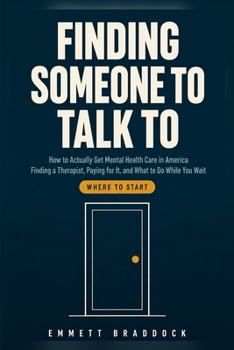
Finding Someone to Talk to

It is 4:40 on a Thursday and the fourth voicemail box you have reached today is full.
You already did the part everyone calls the hardest. You decided. What nobody warns you about is the gap that comes after - phone numbers, web forms, hold music, insurance vocabulary, intake coordinators and waiting lists, standing between you and a room with a qualified person in it. Most people who set out to find care in this country give up at least once, and almost never at a big obstacle. They give up at the eleventh small one.
The premise of this book: wanting help is not the hard part. The system is, and the system can be worked - not beaten, not charmed, but worked, the way you work a permitting office or a warranty claim. It has rules. They are mostly unwritten, occasionally absurd, and entirely learnable.
This is the purely logistical book about getting mental health care in the United States. Not feelings - what a directory listing does not tell you, what "in network" actually means, what a superbill is, what a sliding scale turns out to cost when you ask, what to say when a receptionist says they are not taking new patients. Sixteen chapters break the process into steps that can be done badly and still count, and each one ends with "One thing you can do this week" one small action, never a checklist you can fail.
What's inside:
- Why the decision is the easy part, and the eleven small obstacles that follow it
- What the letters after a clinician's name mean, and who does what, in plain words
- Where fifteen usable names come from, and which sources are worth your afternoon
- Deductible, network, superbill, parity: the American insurance dialect, translated
- Paying without insurance, and what a sliding scale really is when you ask for one
- The first phone call close to word for word, voicemail and follow-up included
- How waiting lists actually work, and why you should be on several
- What to do with the weeks in between so the search does not go stale
- The intake appointment, from the parking lot to the end
- How to tell whether a therapist is a fit, and how to leave one who is not
- Group therapy, community clinics and university training clinics, honestly described
- Care through an employer, a school or the VA, and where each door actually is
- Calling for a teenager, rural distance and telehealth, and the month you want to quit
Plus a plain-English glossary of the terms this process throws at you, and a chapter of scripts: what to say to a receptionist, an insurer, a doctor, an employer, and a clinician you need to leave.
Perfect for: anyone holding a list of names they have not called yet, anyone three months into a waitlist, and anyone doing this for a partner, a parent or a kid.
This is general information about how the US system works, not therapy, medical advice, a diagnosis or a treatment plan; the author is not a clinician of any kind, there is nothing here about medication, and nothing here will tell you what is wrong with you.
Customer Reviews
ThriftBooks ® and the ThriftBooks ® logo are registered trademarks of Thrift Books Global, LLC
