


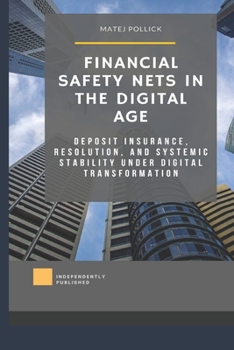
Financial Safety Nets in the Digital Age: Deposit Insurance, Resolution, and Systemic Stability under Digital Transformation

Financial systems are being transformed by digitalization. Stablecoins, tokenized deposits, decentralized finance (DeFi), and platform-based intermediation are reshaping the way money-like liabilities are created, transferred, and stored. Yet the fundamental logic of financial instability has not changed. Liquidity risk, collective withdrawal behavior, and moral hazard remain central to systemic fragility.
Financial Safety Nets in the Digital Age examines how the institutional architecture of financial stability must evolve under conditions of accelerated liquidity and technological transformation. Drawing on the doctrine of deposit insurance, bank resolution, and crisis management frameworks, the book analyzes whether existing safety nets are equipped to address digital run dynamics, cross-border platform fragmentation, and novel forms of money-like liabilities.
The book moves beyond surface discussions of cryptocurrency regulation to explore deeper structural questions:
How should deposit insurance be calibrated when withdrawals occur at digital speed?
Under what conditions are stablecoins or tokenized deposits insurable?
Can decentralized insurance mechanisms substitute for sovereign backstops?
How must resolution regimes adapt to continuously operating digital markets?
What are the fiscal and moral hazard implications of extending public guarantees into new financial domains?
Grounded in financial stability doctrine and informed by regulatory practice, this work provides a structured framework for policymakers, regulators, academics, and financial professionals navigating the intersection of traditional safety nets and digital innovation.
This book is intended for readers engaged in financial regulation, central banking, deposit insurance systems, resolution planning, and systemic risk analysis. It offers a rigorous yet accessible examination of how institutional design must adapt to preserve confidence without eroding discipline in a digitized financial ecosystem.
Customer Reviews
ThriftBooks ® and the ThriftBooks ® logo are registered trademarks of Thrift Books Global, LLC
