


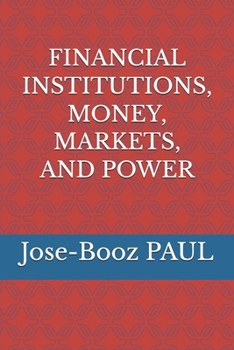
Financial Institutions, Money, Markets and Power
No Customer Reviews

For all its algorithms, derivatives, and sprawling balance sheets, the global financial architecture remains a profoundly human creation. It is built on a foundation of judgment-the loan officer's gut call, the central banker's lonely decision to raise rates. It is sustained by trust-the depositor's faith that their money is safe, the investor's belief that markets are fair. And it is directed by political will-the treaties signed, the regulations written, the priorities chosen.
This magnificent machinery can perform wonders. It can connect a saver in Stuttgart to an entrepreneur in S o Paulo, fund a cure for disease, and build the infrastructure of modern life. But when its gears jam, when trust evaporates and judgment fails, it can destroy livelihoods with terrifying speed, amplifying inequality and sowing social discord.
Studying the architecture of global finance, therefore, is not a sterile technical exercise. It is to engage with one of the most potent forces shaping human destiny in the 21st century. The final test of the system, and of those who steward it, will not be its complexity or its profitability for intermediaries. It will be whether this intricate, awe-inspiring edifice ultimately serves the fundamental needs of the society it was built to support: fostering sustainable prosperity, managing risk with wisdom, and distributing its blessings with a measure of justice. The blueprint is never complete. The next draft is ours to write.
This magnificent machinery can perform wonders. It can connect a saver in Stuttgart to an entrepreneur in S o Paulo, fund a cure for disease, and build the infrastructure of modern life. But when its gears jam, when trust evaporates and judgment fails, it can destroy livelihoods with terrifying speed, amplifying inequality and sowing social discord.
Studying the architecture of global finance, therefore, is not a sterile technical exercise. It is to engage with one of the most potent forces shaping human destiny in the 21st century. The final test of the system, and of those who steward it, will not be its complexity or its profitability for intermediaries. It will be whether this intricate, awe-inspiring edifice ultimately serves the fundamental needs of the society it was built to support: fostering sustainable prosperity, managing risk with wisdom, and distributing its blessings with a measure of justice. The blueprint is never complete. The next draft is ours to write.
Format:Paperback
Language:English
ISBN:B0GZB462X3
ISBN13:9798259376618
Release Date:April 2026
Publisher:Independently Published
Length:52 Pages
Weight:0.18 lbs.
Dimensions:0.1" x 6.0" x 9.0"
Customer Reviews
0 rating
Copyright © 2026 Thriftbooks.com
Terms of Use | Privacy Policy | Do Not Sell/Share My Personal Information | Cookie Policy | Cookie Preferences | Accessibility Statement
ThriftBooks ® and the ThriftBooks ® logo are registered trademarks of Thrift Books Global, LLC
ThriftBooks ® and the ThriftBooks ® logo are registered trademarks of Thrift Books Global, LLC
