


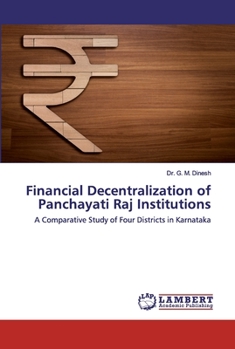
Financial Decentralization of Panchayati Raj Institutions
No Customer Reviews

Decentralisation has emerged as a dominant trend in world economy. In 1998, the World Bank estimated that all but 12 of the 75 developing and transitional countries with populations greater than 5 million had embarked on a process of political devolution. At the heart of this transformation are a number of complex yet inter-related themes. One is an ideological shift, in which the legitimacy of central and state-led development has been challenged on the grounds that it produces systems of governance that undermine national economic performance and effective public policy. To second it a remarkable widespread political agenda, which asserts that the decentralisation of public administration and the introduction of locally elected bodies will produce systems of governance that are better able to meet the needs of poor and politically marginal groups in society. The third related theme suggests that democratic decentralisation is a political strategy that national lites have maintained legitimacy and control in the face of political disintegration.
Format:Paperback
Language:English
ISBN:6202552581
ISBN13:9786202552585
Release Date:May 2020
Publisher:LAP Lambert Academic Publishing
Length:256 Pages
Weight:0.84 lbs.
Dimensions:0.6" x 6.0" x 9.0"
Customer Reviews
0 rating
Copyright © 2026 Thriftbooks.com
Terms of Use | Privacy Policy | Do Not Sell/Share My Personal Information | Cookie Policy | Cookie Preferences | Accessibility Statement
ThriftBooks ® and the ThriftBooks ® logo are registered trademarks of Thrift Books Global, LLC
ThriftBooks ® and the ThriftBooks ® logo are registered trademarks of Thrift Books Global, LLC
