


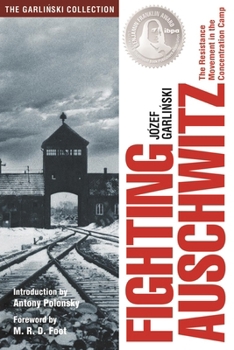
Fighting Auschwitz: The Resistance Movement in the Concentration Camp

Select Format
Select Condition 
Book Overview
"The definitive study of the topic." --Prof. Antony Polonsky, Emeritus Professor of Holocaust Studies, Brandeis University, and Chief Historian, POLIN Museum of the History of Polish Jews. Winner of the SILVER AWARD for HISTORY at the 2019 Benjamin Franklin Awards. The incredible story of underground resistance among the prisoners at the infamous Auschwitz concentration camp. When the Germans opened Auschwitz in June 1940, it was a concentration camp for political prisoners, who were told on arrival that they would live no longer than three months--expanding two years later to also become a death camp for Jews. Underground resistance appeared at Auschwitz very quickly, spearheaded in 1940 by one of the bravest men ever to live, Polish army officer Captain Witold Pilecki. In this meticulously researched and highly readable work, J zef Garliński traces the evolution and operations of the principal resistance organizations among the prisoners (including communist as well as non-communist groups). He delves into the relationships among these groups, as well as their relationships with the various political and multinational factions in the prisoner population, including both male and female, and with the underground outside the camp. He describes their efforts against the brutal SS men and informers. In parallel, he documents the growth and evolution of Auschwitz itself, and the horrors of the industrialized death factory for Jews created by the Germans. First published in English in 1975, but out of print for decades, this seminal book is now being released in a new 2nd edition with more than 200 photos and maps, and a new introduction by Prof. Antony Polonsky. Garliński, a member of the Polish underground during WWII, was himself a prisoner at Auschwitz. With more than 200 photos and maps, five Appendices, extensive Bibliography and detailed Indexes.
Format:Hardcover
Language:English
ISBN:1607720248
ISBN13:9781607720249
Release Date:September 2018
Publisher:Aquila Polonica Publishing
Length:575 Pages
Weight:2.30 lbs.
Dimensions:1.6" x 6.0" x 9.2"
Customer Reviews
1 rating
"Life" at Auschwitz-Birkenau, and Clarification of the Sonderkommandos' Revolt vis-a-vis the Polish
Published by Thriftbooks.com User , 18 years ago
Jozef (Joseph) Garlinski, a member of the Polish Underground, former inmate of Auschwitz, and subsequently a historian, has written an invaluable account about this Nazi German concentration and death camp. There is also an extensive listing of specifically-named individuals. WARNING: Some of Garlinski's descriptions of conditions at Auschwitz, and of Gestapo tortures inflicted upon Underground suspects, are quite graphic, and may be upsetting to sensitive readers. Some forms of resistance at Auschwitz were particularly clever. For instance, certain Polish inmates developed a tiny "bacteriological warfare" lab, which enabled them to culture typhus-bearing lice in order to infect some German guards (pp. 53-54, 141). There were a number of daring escapes conducted by inmates, notably the Poles (pp. 102-103). The first open revolt at the camp was also conducted by Poles (pp. 103-107). Nazi policies towards both Poles and Jews were strictly utilitarian in nature. After the specter of German defeat became increasingly conceivable in 1942, and all able-bodied workers had become sorely needed for the war effort, the Germans spared some Jews for forced labor, and also discontinued the collective killings of Polish inmates as reprisals for revolts and escapes (p. 101, 147). Garlinski touches upon the gassings of Zamosc-area Poles (pp. 144-145). He also discusses the sterilization experiments conducted on Auschwitz inmates by the Germans, and places them in the context of German exterminatory genocidal plans: "Some nations, such as the Jews, and later the Poles and other Slavs, were to be completely, or almost completely, eliminated..." (p. 137). The Polish Underground (AK), throughout German-occupied Poland, had very few weapons in 1943 (p. 161). While not considered in this light, this helps the reader understand why the Underground gave only a modest number of weapons to the Warsaw Ghetto fighters. Garlinski also reports that most of the German-serving Polish informers, at least at Auschwitz, had initially been loyal Poles who had been broken by Gestapo tortures (p. 138, 273). One wonders how many of the Poles who betrayed fugitive Jews elsewhere also fit into this category. Two Slovak Jews, Walter Rosenberg and Alfred Wetzler, escaped from Birkenau with the help of a Polish Underground cell in the camp (p. 233). They were later assisted by local Poles in their flight to Slovakia. Eventually, they informed some skeptical Slovak Jewish officials about the extermination of Jews at Birkenau. In time, Rosenberg met with the papal Nuncio regarding the same. The Sonderkommandos of Birkenau, mostly Jews but also some Poles and Russians (p. 244), were forced to assist the Germans in the gassing of inmates and the subsequent plundering and cremation of the corpses. The Sonderkommandos were periodically killed off by the Germans in order to eliminate eyewitnesses. For this reason, as the gassing of the Hungarian Jews was drawing to an end in 1944, the
Copyright © 2026 Thriftbooks.com Terms of Use
| Privacy Policy | Do Not
Sell/Share My Personal Information | Cookie Policy | Cookie Preferences | Accessibility Statement
ThriftBooks® and the ThriftBooks® logo are registered trademarks of Thrift Books Global, LLC
ThriftBooks® and the ThriftBooks® logo are registered trademarks of Thrift Books Global, LLC
