


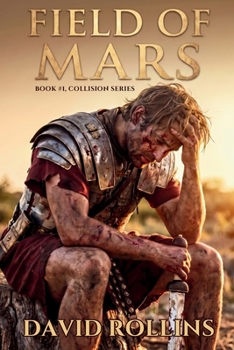
Field of Mars

53 BC. On the sun-scorched plains of Mesopotamia, Marcus Licinius Crassus, the richest man in Rome, marches forty thousand legionaries into Parthia in search of the one thing his fortune could never buy him: military glory to rival Caesar and Pompey.
He finds annihilation instead. Led by the brilliant Parthian general Surenas, an enemy force a fraction of the legions' size will encircle and destroy them with an endless, merciless rain of arrows, exposing Crassus's arrogance and Rome's own blind faith in the invincibility of the legion.
At Carrhae, Parthian horse archers and armored cataphracts tear the legions apart on ground of their own choosing. Crassus's son Publius falls on his own sword rather than be taken. Crassus himself is dead within days, the golden ending the old stories always warned him about. Of the proud army that marched east, ten thousand men are killed. Ten thousand more are taken alive.
Among the survivors is Tullus Bassius Rufinius, a young non-commissioned officer who has never led anything larger than a single contubernium, and Appias Cominius Maro, the campaign's reluctant historian, dragged along to record a triumph that never came. When the officers who should have led them are dead, it falls to Rufinius to hold the survivors together through a death march across the desert and into slavery.
Sold like cattle in the markets of the east, the legionaries are marched further still, deep into the territory of the Xiongnu, a nomadic empire that has never seen anything like the discipline of a Roman shield wall. There, Rufinius and his men are handed a brutal choice: die as slaves, or fight as mercenaries for a foreign king who owns them body and soul.
What follows is a story of survival against impossible odds, of a woman who becomes far more than the disguise she hides behind, of an old prophecy that promises Rufinius will live forever, and of a ragged legion with no homeland, no emperor, and no way home, forging an identity that is no longer entirely Roman and not yet anything else.
Rufinius quickly proves he is more than a fighter. He is a leader men will follow into a country whose name they cannot pronounce, and a husband to a woman whose survival has depended on being someone she is not. Around him gathers the remnant of his old contubernium, foul-mouthed and battle-scarred, more loyal to each other than to any eagle standard, and it is this small brotherhood, as much as Rufinius himself, that carries the emotional weight of the novel through slave markets, frozen sieges, and the intrigue of a foreign king's court. Appias, meanwhile, survives less by the sword than by his wit, his pen, and his gift for making himself useful to whoever currently owns him, and it is through his eyes, decades later and half a world away, that this entire story is finally set down.
Field of Mars is inspired by one of history's most tantalizing unsolved mysteries: the fate of the Roman soldiers lost after Carrhae, and the theory that some of them marched all the way to the frontier of Han China, where a remote town's residents would, centuries later, be found with startlingly Roman features.
Customer Reviews
ThriftBooks ® and the ThriftBooks ® logo are registered trademarks of Thrift Books Global, LLC
