


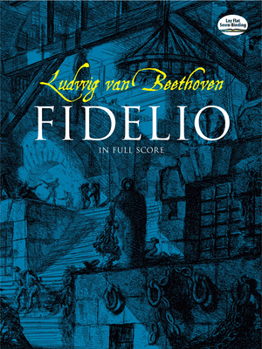
Fidelio in Full Score


Select Format
Select Condition 
Book Overview
Beethoven's only opera, Fidelio is a unique, enduring masterpiece of loyalty, unselfish love, and the human spirit -- the story of the faithful Leonora who risks everything to free her husband, Florestan, from unjust imprisonment. Though the plot line and the form of the libretto are far from unique, Beethoven -- after a decade of unceasing revision -- was able to rise above the limitations of the material and infuse it with transcendent nobility.
"Of all my children," the composer said, "this is the one that cost me with worst birth pangs . . . and for that reason it is the one most dear to me." Audiences and musicians have long shared Beethoven's sentiments, making Fidelio one of the most performed, most studied, most recorded operas of all time.
This reliable edition from Dover reproduces the full orchestral and vocal score, with ample space in the margins for analytical notation. In one sturdily bound, inexpensive volume, here is Beethoven's genius for orchestration combined with the drama of the human voice in choruses, duets, emotion-filled arias, and an intense finale.
More than anything else, the idealistic themes of the opera -- justice, freedom, heroism, love -- inspired Beethoven to transcend the libretto and forge a musical structure that far surpasses the literary foundation on which it is built. Whether in a humorous aria, such as "Hat man auch nicht Geld beineben," or a glorious four-part canon, such as "Mir ist so wunderbar," the music carries the words to a plane far beyond themselves.
Reprinted in its entirety from the authoritative C. F. Peters edition, this faithful edition of the well-loved Fidelio will delight music lovers, opera enthusiasts, Beethoven devotees, teachers, and students -- not least of all for its remarkably affordable price.
Customer Reviews
This is what you want
Beethoven's only Opera
ThriftBooks® and the ThriftBooks® logo are registered trademarks of Thrift Books Global, LLC
