


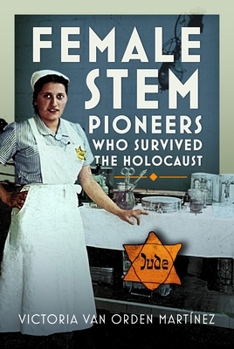
Female Stem Pioneers Who Survived the Holocaust
No Customer Reviews

Women who survived the Holocaust forged STEM paths amid gender barriers, transforming science despite immense sacrifice.
Women who pursued careers in science and medicine in the wake of the Second World War faced a multitude of obstacles due to their gender. Structural, institutional, and social barriers and attitudes kept women's participation in science, technology, engineering, and math (STEM) low and their advancement and recognition even lower. But these were not the only obstacles faced by women who survived the Holocaust and became STEM pioneers.
The book highlights not only the important contributions to STEM made by well-known scientists Nobel Laureate (1986) Rita Levi-Montalcini, internationally-renowned cancer researcher Eva Klein, and four women whose pioneering work is less well known, but also recounts the women's individual experiences during the Second World War and the Holocaust in Germany, The Netherlands, Italy, Czechoslovakia, Hungary, and Poland, and in Nazi concentration and labor camps and hiding, as well as in the aftermath. As refugees, migrants, and eventually citizens in the United States, Canada, and Sweden, their experiences shifted from surviving the Nazis to navigating education and careers in the male-dominated professional fields of neurobiology, biochemistry, hematology, cardiology, and cancer immunology. While for these women, glass ceilings, sexism, and the other challenges they faced in their scientific careers might have seemed inconsequential compared to Nazi persecution, their stories demonstrate that their accomplishments were not achieved without difficulty and sacrifice.
Women who pursued careers in science and medicine in the wake of the Second World War faced a multitude of obstacles due to their gender. Structural, institutional, and social barriers and attitudes kept women's participation in science, technology, engineering, and math (STEM) low and their advancement and recognition even lower. But these were not the only obstacles faced by women who survived the Holocaust and became STEM pioneers.
The book highlights not only the important contributions to STEM made by well-known scientists Nobel Laureate (1986) Rita Levi-Montalcini, internationally-renowned cancer researcher Eva Klein, and four women whose pioneering work is less well known, but also recounts the women's individual experiences during the Second World War and the Holocaust in Germany, The Netherlands, Italy, Czechoslovakia, Hungary, and Poland, and in Nazi concentration and labor camps and hiding, as well as in the aftermath. As refugees, migrants, and eventually citizens in the United States, Canada, and Sweden, their experiences shifted from surviving the Nazis to navigating education and careers in the male-dominated professional fields of neurobiology, biochemistry, hematology, cardiology, and cancer immunology. While for these women, glass ceilings, sexism, and the other challenges they faced in their scientific careers might have seemed inconsequential compared to Nazi persecution, their stories demonstrate that their accomplishments were not achieved without difficulty and sacrifice.
Format:Hardcover
Language:English
ISBN:1036125769
ISBN13:9781036125769
Release Date:November 2026
Publisher:Pen and Sword History
Length:224 Pages
Customer Reviews
0 rating
Copyright © 2026 Thriftbooks.com
Terms of Use | Privacy Policy | Do Not Sell/Share My Personal Information | Cookie Policy | Cookie Preferences | Accessibility Statement
ThriftBooks ® and the ThriftBooks ® logo are registered trademarks of Thrift Books Global, LLC
ThriftBooks ® and the ThriftBooks ® logo are registered trademarks of Thrift Books Global, LLC
