


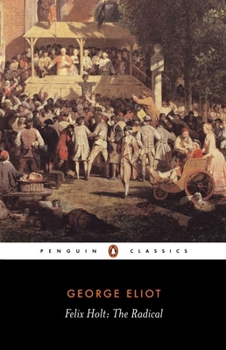
Felix Holt, the Radical


Select Format
Select Condition 
Book Overview
When the young nobleman Harold Transome returns to England from the colonies with a self-made fortune, he scandalizes the town of Treby Magna with his decision to stand for Parliament as a Radical. But after the idealistic Felix Holt also returns to the town, the difference between Harold's opportunistic values and Holt's profound beliefs becomes apparent. Forthright, brusque and driven by a firm desire to educate the working-class, Felix is at first viewed with suspicion by many, including the elegant but vain Esther Lyon, the daughter of the local clergyman. As she discovers, however, his blunt words conceal both passion and deep integrity. Soon the romantic and over-refined Esther finds herself overwhelmed by a heart-wrenching decision- whether to choose the wealthy Transome as a husband, or the impoverished but honest Felix Holt.
Format:Paperback
Language:English
ISBN:0140434356
ISBN13:9780140434354
Release Date:December 1995
Publisher:Penguin Classics
Length:592 Pages
Weight:0.80 lbs.
Dimensions:1.4" x 5.2" x 7.8"
Age Range:18 years and up
Grade Range:Postsecondary and higher
Customer Reviews
5 ratings
Radically good
Published by Thriftbooks.com User , 17 years ago
The first Reform Bill has just passed. The wealthy squire Harold Transome is set to compete against the more deserving, labouring Felix Holt on the same Radical ticket to the local borough seat. And they soon become unwitting rivals in another arena, for the heart of the book's real heroine, Esther Lyon, the dissenting minister's daughter. 'Felix Holt' is a rich novel: both political speculation and comedy of manners. It portrays 19th century election processes in their full, colourful detail: corruption, intimidation, vote-buying and all, while leaving room for hope and ultimately painting a fascinating picture of nascent democracy. It is also endowed with George Eliot's subtle dialogue and keen eye for psychological and social nuance. I have only read Middlemarch by the same author. The much thicker and better known work has a wider cast of characters and, with its more slowly-paced plot, it provides a deeper analysis of early Victorian country mores, but it is also a more classical piece of social study. `Felix Holt' is a busier, rowdier novel, yet I found it just as convincing and engaging in its characters and relations. It is entertaining on multiple levels; this is a book that appeals both to readers with a historical interest and to those simply looking for a good intrigue. Highly recommended.
Underrated
Published by Thriftbooks.com User , 22 years ago
George Eliot is an acquired taste. If one were to pick up only one of her books it would probably be "The Mill on the Floss", "Silas Marner" or "Middlemarch" and with any one of those might come frustration with Eliot's myriad of plots (not to mention her tendency for being a bit wordy). But I found "Felix Holt", for all its political twists and turns, to be the most accessible of Eliot's books. This accessibility can be attributed to two of the finest characters ever created: Mrs. Transome and Ester Lyon. I would say that the character of Mrs. Transome ranks up there with Emma Bovary in terms of literary creation and chapters 42 and 49 (I don't want to give away the story) are absolutely cinematic. I truly love this book.
Felix Holt - A Literary Hero to Fall in Love with...
Published by Thriftbooks.com User , 24 years ago
This is my 4th novel by George Eliot (after "Adam Bede", "Middlemarch" and "The Mill on the Floss") and it has become my favourite along with "Middlemarch". "Felix Holt" is so marvelously written and gave me many hours of reading pleasure - I can't understand why it's not as highly acclaimed or well-known as Eliot's other novels.If you're a fan of Victorian literature, then you mustn't miss this brilliant work. The story's set in the 1830s and is 1/3 focused on politics (i.e. a fascinating insight into the electioneering process and the fight for a Parliamentary seat between the Torys and the Radicals), 1/3 on family and sensational issues (e.g. illegitimacy, dispute over who has the legitimate claim on the wealthy estates of the Transome family and plenty of blackmail, manipulation and betrayals) and 1/3 devoted to a love triangle.George Eliot wrote so eloquently and beautifully that many times I find myself re-reading a particular phrase in order to saviour its beautiful words. Each chapter also starts with either a beautiful poem or some well-chosen lines from Shakespeare/the Classics. Here's a favourite of mine from Chapter 45 (a poem by Eliot):"We may not make this world a paradiseBy walking it together with clasped handsAnd eyes that meeting feed a double strength.We must be only joined by pains divine,Of spirits blent in mutual memories".I confess that above all, it is the suspense over the touching love story that kept me turning the pages very quickly. The hero is Felix Holt, a passionate, idealistic young man who studies medicine but chooses to quit midway and forgo a comfortable future as a doctor in favour of leading the more righteous life (in his opinion) of an ordinary, poor workingman because of his scorn for wealth and its corrupting powers. Felix is described as honest, brusque, generous and highly intelligent. He's got "wild hair", dresses simple and to his own liking e.g. not wearing a cravat "like all the other gentlemen", and sometimes looks like a "barbarian". He patronizes no one and is rather unpopular in the town of Treby Magna where the story takes place. His political views are Radical (i.e. more severe than the Liberals) but his main concerns are for the well-being of the working class and especially the future of their children. (Read the excellent "Address to Working Men by Felix Holt" which comes after the Epilogue). Felix's good intentions land him in great trouble with the law later on when a massive riot breaks out among the drunk working class directly after the election and Felix is wrongly accused of being the leader of the mob.Early on in the novel, Felix is introduced to the heroine, Esther Lyon (the beautiful daughter of a poor chapel minister) whose vanity and high-bred manner he scorns. He rebukes and lectures her constantly in that straight-forward and honest manner of his because he cares to improve her views on what are truly the important things in life. Esther dislikes him utterly at first... she ca
Perfect reading for an election year
Published by Thriftbooks.com User , 25 years ago
I've heard a lot of moaning this year about how democracy is dead and how much better things were in the good old days. Eliot's unromantic view of human nature is the perfect cure for all that. As she tells it, people were dumb, and cunning, and selfish back then - just as they are today. The biggest difference was that most people weren't allowed to vote: "universal suffrage" was about as beyond-the-pale then as gay marriage is today.Here's the TV preview version: _Felix Holt_ is a lively mix of barroom treating, soapbox preachers, riots, bribery, "irregularities," and a courtroom scene with a shocking finale! One caveat: readers spoiled on modern pap may find this novel difficult going. But it's worth it.
Wonderful novel of 19th century society.
Published by Thriftbooks.com User , 26 years ago
Felix Holt combines themes of political responsibility and social concern amidst the background of a community that is facing problems involved with the rapid industrialization of the country. Eliot depicts a village caught in a battle between tradition and progressivism. The characters who make up this struggle are brilliantly portrayed. There is even a sweet romantic twist to the story that renders it even more enjoyable. Eliot gives one the impression that in order for society to make advances for the good of all, some people must willingly give up the prosperity and status that accompanies a largely capitalistic state. It is through such noble acts that those less fortunate can gain a voice in a system that constantly represses them. This is the major theme of this incredible novel.
Copyright © 2026 Thriftbooks.com Terms of Use
| Privacy Policy | Do Not
Sell/Share My Personal Information | Cookie Policy | Cookie Preferences | Accessibility Statement
ThriftBooks® and the ThriftBooks® logo are registered trademarks of Thrift Books Global, LLC
ThriftBooks® and the ThriftBooks® logo are registered trademarks of Thrift Books Global, LLC
