


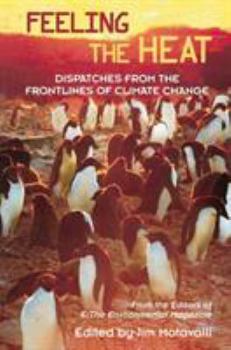
Feeling the Heat: Dispatches from the Front Lines of Climate Change

Select Format
Select Condition 
Book Overview
For an increasing number of people, global warming is not an academic and scientific debate, but a matter of survival. As the planet warms at a rate of four degrees Fahrenheit per century, violent storms are increasing in frequency, icebergs are melting, sea level is rising, species are losing their habitats, and temperature records are being broken. Feeling the Heat consists of chapter-length visits by well-known authors to actual world "hot" spots, where people are already coping day-to-day with the consequences of climactic disruption. The locations for the book were strategically chosen because each represents a separate and important global warming impact, such as rising tides, melting glaciers, evolving ecosystems and air pollution. Feeling the Heat takes global warming out of the realm of armchair speculation and arcane scientific debate, revealing the process of climate change to be ongoing, serious and immediate.
Format:Paperback
Language:English
ISBN:0415946565
ISBN13:9780415946568
Release Date:May 2004
Publisher:Routledge
Length:216 Pages
Weight:0.85 lbs.
Dimensions:0.6" x 6.2" x 9.2"
Customer Reviews
4 ratings
Learning by example
Published by Thriftbooks.com User , 21 years ago
It is usually easier to understand multifaceted issues through specific case studies and illustrations. Climate Change and Global Warming are very complex concerns indeed. Many people do not want to see the realities confronting us. Many skeptics argue that climate change is a phenomenon of nature and/or something delayed to the future. Indications from far away places need not concern us. Raising temperatures by 0.6 degrees C is hardly worth thinking about. If it means that we have warmer weather for a few weeks longer, that can only be comfortable for people living in northern climes. Not so, argue Jim Motavalli and his colleagues. The intricacies of climate change and recent warming trends in remote places such as Alaska and the Antarctic reveal that the warming of the planet impacts us all already. In a selection of "dispatches" compiled by the editors of E/The Environmental Magazine, a distinguished group of environmental reporters traveled the world - from Australia to the Pacific Northwest, from China to Europe, to record scientific assessments and human experiences. What can we learn from their observations? A case of severe human impact on the environment is vividly explored in "The Cost of Coal" in Mark Heertsgard's report from China. Rapid economic development comes at a very high price. For the time being, the prime energy source there remains fossil fuels, resulting in extreme air pollution. Thick smog covers the cities and people suffer from respiratory and other health problems. Yet, if the alternative is to freeze in unheated houses or slowing down the industrial advances, Chinese see no choice. Aware of CO2 greenhouse gas emissions almost rivaling those of the (highest emitter) USA, Chinese politicians and technocrats showed little sympathy for the global impact. They dismiss it as "the cost of progress". At the same time, Chinese authorities regulate industry towards high level of energy efficiency. Closer to home for many readers is a wake-up call on raising sea levels. Motavalli and Barnes paint a devastating picture of what is in store for Greater New York from the underappreciated impact of global warming. Not only the tourist industries as the beaches of Florida or Fiji will suffer destruction, island states in the Pacific Ocean are already preparing for the exodus of hundreds of thousands of environmental refugees. The trends are unmistakable. On the other hand, examples from Europe provide a glimmer of hope. No longer waiting or sitting on the fence, Europeans have taken the lead in "planning ahead", proving that increasing use renewable energy and economic growth can be combined successfully. Writing about insects and other creatures appearing in ecosystems where they don't belong, several articles demonstrate that the ecosystem balance is under threat. Warming ocean water results in fish and other sea animals moving out of their traditional habitats. Their food sources may not have
Glimpsing our globe's grief
Published by Thriftbooks.com User , 21 years ago
The human aspect of climate change is finally emerging into general view. Long dominated by measurements and struggles to pinpoint sources, this book describes how people are affected when weather becomes chaotic. As a collection of "dispatches from the frontlines" it chronicles what our neighbours [and ourselves] are experiencing. How are people coping with rising sea levels, shifting landforms and waning resources? This outstanding anthology of essays may be rightly equated with "war reporting" since it covers the battles for survival we are now engaged in. The only missing elements are generals to lead the fight and strategies to apply. Both are sadly lacking. In but ten essays, the various authors portray changing local environments around the planet. Asian, European, North American and Pacific conditions are reported and comparisons offered. In Europe, Denmark stands as a bastion against polluting energy sources while enjoying continued prosperity. There, wind energy is being utilised to curb fossil fuel power station emissions. The turbines are finding markets in other EU nations, particularly Spain and Germany - each of which have greater windpower capacity than that of the United States - a telling statistic. North Americans are slow to see the reality of conditions elsewhere. Asia, with its still burgeoning population, relies heavily on polluting fuels. Wood, pressed coal, even dung, all remain major fuels for heating and cooking - fundamentals in daily life. Such fuels produce soot and dust, which have produced a cloud over the Indian Ocean covering 10 million square miles. More than just an irritant - "you get used to it", one author relates - the cloud interrupts the food chain at sea. High altitude winds bring the particles to North America's West Coast. The dust bears micro-organisms as cargo, leading to "unexplained outbreaks" of viral infections. From the other direction, one-inch grasshoppers from Africa have appeared in the Caribbean. Clearly, the scenario is global. Above the Caribbean, New York is already seeing the impact of rising sea levels. Wetlands are "developed" or flooded by salt water. "Exiled" species have nowhere to move, thus die out for lack of habitat. In the West, glaciers are shrinking, depleting the available water supplies for growing cities and struggling farms. Fish stocks are declining with the water loss. Warming oceanic water leads to species moving into new habitats. While this may be of temporary benefit, major foodstock species are losing ground, cascading the impact throughout the ecosystem. The picture is grim, but not hopeless. Mechanisms exist to reduce the growing problem, but they must be more fully adopted. Motavalli is unequivocal in his denunciation of the current US administration. Compounded by media withdrawal of criticism, he argues that a "Manhattan Project" level of action is required. Motavalli argues that the Bush administration has declared "we mus
A"Wake-Up Call for Global Climate Change!"
Published by Thriftbooks.com User , 21 years ago
Editor Jim Motavalli has done an outstanding job of putting together a keleidoscopic picture of Global Climate Change by presenting a coherent and incisive selection of captivating essays, from a variety of scientific and jouranlistic perspectives. Even the most hardened skeptic could not help but be convinced that unless we act swiftly to wean ourselves from our obsessive addiction to Fossel Fuels, clean up our act in terms of Environmental Pollution, and shift our present Ways of Living and Thinking into a Sustainable Framework, the present and future inhabitants of Spaceship Earth are in for a rude awakening! If there were a New York Times Bestseller List for Ecological Books, this book would most certainly be included. For anyone interested in keeping abrest of the latest scientific evidence for Global Warming, buy this book and read it...from cover to cover! Elliott Maynard, Ph.D., President, Arcos Cielos Research Center, Sedona, Arizona.
A set of thought-provoking, chilling facts
Published by Thriftbooks.com User , 21 years ago
One would anticipate a discourse on climatic change to be a dry, scientific presentation relatively weighty for lay readers: not so with compiled and editor Jim Montavalli's Feeling the Heat: Dispatches from the Frontlines of Climate Change, which provides articles written by articulate contributors drawn from the front lines of the world's 'hot spots' where serious climate shifts are already in progress. From a 2003 European heatwave which killed 10,000 in France alone to the rising of the sea level in California, Feeling The Heat provides a set of thought-provoking, chilling facts.
Copyright © 2026 Thriftbooks.com Terms of Use
| Privacy Policy | Do Not
Sell/Share My Personal Information | Cookie Policy | Cookie Preferences | Accessibility Statement
ThriftBooks® and the ThriftBooks® logo are registered trademarks of Thrift Books Global, LLC
ThriftBooks® and the ThriftBooks® logo are registered trademarks of Thrift Books Global, LLC
