


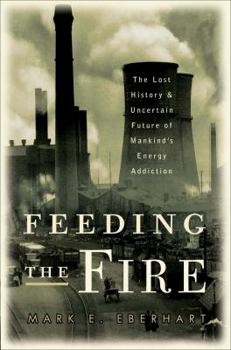
Feeding the Fire: The Lost History and Uncertain Future of Mankind's Energy Addiction


From the first spark created by human hands thousands of years ago, mankind has grown dependent on nature's vast stores of energy to build, explore, and experiment. Our expanding knowledge and technologies have come from the felling of forests to the harnessing of wind and water, from the burning of coal and oil to tapping the energy of the atom. Energy does more than heat our homes and fill our gas tanks; it fuels our imaginations. Our future is inextricably linked to energy, and in this groundbreaking book, Mark Eberhart examines our historic quest for power and tackles the brutal realization that there are limits to the energy Earth can provide. In Western society, we treat energy as a given-the background noise of modern life. But as worldwide energy demand grows, supplies are, at best, holding steady-and at worst, shrinking. The implications of our dependence are enormous. And while there is evidence that great cultures of the past-the Maya, Anasazi, Easter Islanders-collapsed when their energy resources were exhausted, Eberhart argues that we have the responsibility and the ability to develop renewable energy sources now. Eberhart leads us on a tour through the history of energy, how it was formed and how it evolved, and reveals how we became energy-dependent creatures. With an unblinking eye, he takes a close look at the consequences of our energy appetite, and, most important, imagines a secure energy future that we can all play a part in achieving. Enlightening, bold, and practical,Feeding the Fireweaves together history, science, and current affairs to create an important and compelling thesis about humanity's energy needs-and draws a hard line on the imperative need to avert the catastrophe that looms if we continue on our present course.
Format:Hardcover
Language:English
ISBN:0307237443
ISBN13:9780307237446
Release Date:May 2007
Publisher:Crown Publishing Group, The
Length:304 Pages
Weight:1.15 lbs.
Dimensions:9.8" x 1.0" x 6.5"
Related Subjects
Engineering Science Science & Math Science & Scientists Science & Technology TechnologyCustomer Reviews
5 ratings
The Story of How Energy Was Created and How it has Been Utilized
Published by Thriftbooks.com User , 17 years ago
The author begins the book with the basic physics needed to understand energy and how it operates. From there, the author moves on to the Laws of Thermodynamics and molecular energy and follows that with a history of the Big Bang and how energy was created. Moving on, the author details how energy was harnessed and used by man for the advancement of man and follows into today's usage of energy. He finishes the book with a plan for energy independence in the United States in the future. While the book was interesting, and contained some wonderful information, the writing was spotty. Some areas were well written and easy to follow, while others were dense and difficult to read. My greatest criticism is the amount of time spent on the Big Bang theory and molecular energy. Both could have been shortened and written so as to be more easily followed. This is generally a good book for students and people with little understanding of how energy works. I would rate it slightly above introductory level. It certainly is not for individuals with a working knowledge of physics and energy principals. Generous with 4 stars...more like 3.5 stars is appropriate.
Enjoyable & informative history lesson
Published by Thriftbooks.com User , 18 years ago
If you have an interest in - or concerns about - human energy use and, like me, you enjoy a bit of humour as you read abut weighty things, you may find this book worthwhile. That the author is an educator (Professor at the Colorado School of Mines) becomes quickly obvious as he immediately starts working in metaphors and analogies to communicate the sometimes abstruse concepts that exist in (energy) physics(Don't worry, it's only the first part of the book). Sometimes his efforts I found helpful and other times they didn't help my understanding (though I admit to a certain level of personal obtuseness in conceptual understanding from time to time). Sometimes, the concepts are simply huge but quite fascinating; e.g his explanation of the evolution of energy from the moment of the Big Bang, the connection to entropy and the formation of the various elements over time (even if some of the details in his explanation left me bamboozled). The book begins,as noted above, by looking at some of the physics of energy and, quite literally, what it is. He explains the first two laws of thermodynamics in a way that provides a useful foundation for the later material and, in particular, context for how we might make decisions regarding energy sourcing and consumption. Next comes the section I found hardest to navigate: the physics theory, including many of the scientific personalities involved and their contributions. It is really interesting to read but sometimes left my brain hurting. The author provides substantial history on the human use of energy over the millennia and explains in sufficient and informative detail the effects of the several injections of disruptive technologies into societies such as fire, agriculture, draft animals, steam engines, electricity, etc. and the transitions from one fuel type to another - e.g. wood to coal to petroleum to nuclear. This is, in my opinion, the strongest part of the book (though equal mention goes to his anecdotes of a mischievous childhood and the downsides of a curious child learning to read -- equations of very instantaneous, wildly exothermic chemical reactions, for example). Toward the end of the book, the author provides a simplified policy road map to a future of "clean and abundant energy" for all of humanity. It is in this section that he failed, in my view, to bring the same degree of completeness to his arguments that he brought to earlier sections. He decries "wishful thinking" energy policy-making in Washington and elsewhere: "(page 245) In the back of our leaders' minds the belief dwells that if the inevitable can be held off long enough, science and technology will come to the rescue. In other words, they are wishing for a solution. As the cost of energy climbs ever higher, they firmly believe the innovators of the free market will ride in on white courses. They wish oil companies will find new reserves. They wish bright young scientists at the underfunded National Renewable Energy Labor
A history of energy use - and depletion
Published by Thriftbooks.com User , 19 years ago
In the world of books on sustianability, global warming and peak oil, this one is a bit different. Its focus is on presenting the energy lessons of the past. Mr. Eberhart (a prof. of material science and chemistry) takes the reader through the early days of the rather inefficient hunter-gathers which evolved to argicultural-based societies that harnesses the outside energy of donkeys and horses to increase efficiency... then to the use of wood and wood charcoal which further freed up time for mankind to think more creatively ... then with the discovery of coal (and kerosene) which powered cities like London and early American villages ushering in the industrial era, steam engines and steel mills ... up till the big jackpot of the most energy-dense material discovered - oil - which has been a main reason for the innovations and wealth creation of developed nations like ours. In each era, the author interesting shows how the laws of thermodynamics apply to constain its use and how society increasingly used energy to do more of work, leaving more time to create "the next big thing." Most importantly, he reviews many a societies' demise that did not manage their energy resources - the early Mayan civilization and much of Europe (in the mid centuries) who stripped their forests bare, leading to a crisis and near great receeding of society. Of course this leads us to today with our management of oil resources. Will we follow the path of history and ignore the inevitable? The author does proposes way out: a new way of thinking akin to the military/gov't/industrial complex that has worked closely, cooperative and towards the same long-term plan for decades. Take that model and apply it in an energy partnership between government and industry that looks at the hard facts of energy balance and thermodyamics (like the fact that the internal combustion engine is completely inefficient compared to electric engines) and sets long-term goals and performance benchmarks. Will it happen in our current climate of politics and capitalism-at-all-costs? One can only hope so and advocate for it. To me the most valuable contribution this book makes is its giving us a solid history lesson in energy creation and use. He gives us some new foundations for forming our policies and comclusions regarding our energy future. And its one that the non-technical person can follow as well as the engineer/scientist. I found this book more interesting that I expected. It gives a valuable background to better understand the implications of peak oil based on how past soceities have handled their "peak wood" and other energy dilemmas.
A Journey Through Time and Space
Published by Thriftbooks.com User , 19 years ago
In a concise presentation that is both enlightening and entertaining, Eberhart ties together physics, biology, chemistry, thermodynamics and politics. Energy, according to Eberhart, is the sine qua non of our existence. Conservation of energy, a well-known scientific principle, is often not intuitively obvious, but the clarity of Eberhart's presentation and personal examples goes a long way toward making it so. Feeding The Fire is not yet another lecture on how we should all use EnergyStar appliances and ride bicycles to work (despite the benefits that might derive from doing so). It is rather a concise history of energy in the universe as we know it, presented in a way that is both scientifically accurate and completely accessible to a lay reader. Without attempting to write a prescription for the future, it lays a groundwork of understanding that should be a pre-requisite for those who have (or will have) the responsibility of shaping energy policy. I recommend it as required reading for legislators, presidents, vice-presidents, historians and anyone who has the slightest interest in the survival of Earth beyond 2050.
Feeding the Fire
Published by Thriftbooks.com User , 19 years ago
"Feeding the Fire" The lost history and uncertain future of Mankind's energy addiction - delivers even more than its title promises. It is indeed a history of man's relationship with energy, and our current energy affairs - it is also a wonderfully entertaining, and accessible primer on the science of energy. I love a book that both makes me feel both smarter when I have finished reading it, and at the same time completely pleased with the experience of reading it. This book accomplishes both goals. It is science writing in the vein of Carl Sagan and Lewis Thomas. I strongly recommend it.
Copyright © 2026 Thriftbooks.com
Terms of Use | Privacy Policy | Do Not Sell/Share My Personal Information | Cookie Policy | Cookie Preferences | Accessibility Statement
ThriftBooks ® and the ThriftBooks ® logo are registered trademarks of Thrift Books Global, LLC
ThriftBooks ® and the ThriftBooks ® logo are registered trademarks of Thrift Books Global, LLC
