


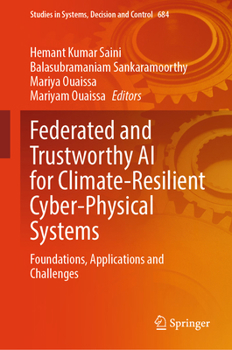
Federated and Trustworthy AI for Climate-Resilient Cyber- Physical Systems: Foundations, Applications and Challenges
No Customer Reviews

This book provides a timely and much-needed examination of how Federated and Trustworthy Artificial Intelligence (AI) can address the real-time challenges posed by climate change on cyber-physical systems (CPS) and Internet of Things (IoT) infrastructures. With extreme weather events, energy shortages, agricultural disruptions, and urban vulnerabilities on the rise, there is an urgent demand for intelligent, distributed, and resilient solutions that can safeguard critical infrastructures while ensuring sustainability and trust.
The central premise of this book is that traditional centralized AI is no longer sufficient. Centralized models face serious limitations: they consume vast energy resources, expose sensitive environmental and operational data, and often collapse under communication bottlenecks during crises. In contrast, federated learning enables distributed IoT devices and CPS nodes to collaboratively train models without sharing raw data, reducing latency, preserving privacy, and improving system adaptability. Coupled with trustworthy AI principles--explainability, fairness, robustness, and transparency--this approach becomes indispensable for climate-resilient operations. This book emphasizes real-time, high-impact applications where federated and trustworthy AI are urgently required: -Smart energy grids that must dynamically balance renewable sources under fluctuating demand and unpredictable climate patterns.-Precision agriculture where IoT-enabled drones and sensors monitor soil, water, and crops under changing rainfall and temperature conditions, ensuring food security.
-Disaster management systems that coordinate distributed sensors and autonomous agents for early warning, evacuation, and recovery during floods, wildfires, or storms.
-Sustainable transportation networks that adapt to heatwaves, fuel constraints, and emissions targets while ensuring public safety.
-Water and waste management systems that require predictive, trustworthy decision-making to remain functional during droughts and pollution spikes.
Format:Hardcover
Language:English
ISBN:3032288460
ISBN13:9783032288462
Release Date:July 2026
Publisher:Springer
Length:449 Pages
Customer Reviews
0 rating
Copyright © 2026 Thriftbooks.com
Terms of Use | Privacy Policy | Do Not Sell/Share My Personal Information | Cookie Policy | Cookie Preferences | Accessibility Statement
ThriftBooks ® and the ThriftBooks ® logo are registered trademarks of Thrift Books Global, LLC
ThriftBooks ® and the ThriftBooks ® logo are registered trademarks of Thrift Books Global, LLC
