


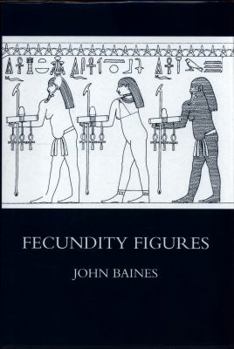
Fecundity Figures: Egyptian Personification and the Iconology of a Genre
No Customer Reviews

Select Format
Select Condition 
Book Overview
Formerly known as 'Nile gods', fecundity figures - personifications ofaspects of non-sexual fertility - have a significant role in thesophisticated iconography of ancient Egypt. In his pioneering study, first published in 1985, John Baines introduces new approaches toEgyptian art and symbolic classification through a study of thisdistinctive genre.
Part 1 analyses the definition ofEgyptian personifications, whose role has parallels in many cultures.The focus is on 'formal' personifications - abstractions in languagethat are names of deities, such as 'Order' or 'Food'. Emblematicpersonifications are their visual counterparts, signs in the script forconcepts like 'Life' that become actors with added human limbs.
Part2 investigates fecundity figures. Their form and its meaning areanalysed, as well as the range of their names. The two principal scenetypes in which they occur, bringing offerings and the heraldic 'unitingof the Two Lands', are reviewed separately.
An excursusstudies the principle of artistic decorum through the distribution andcompatibility of scene and figure types including emblematicpersonifications. This concept has been very influential in Egyptologysince it was introduced in Fecundity figures.
Theconcluding chapter reviews abnormal contexts for fecundity figures, bringing together and extending the findings of the two parts. Anappendix presents and analyses the patterning of colour on fecundityfigures in the context of cross-cultural issues in colour classification.
Format:Hardcover
Language:English
ISBN:0900416785
ISBN13:9780900416781
Release Date:January 2001
Publisher:Peeters
Length:454 Pages
Weight:2.45 lbs.
Dimensions:1.3" x 6.7" x 9.8"
Customer Reviews
0 rating
Copyright © 2026 Thriftbooks.com
Terms of Use | Privacy Policy | Do Not Sell/Share My Personal Information | Cookie Notice | Cookie Preferences | Accessibility Statement
ThriftBooks ® and the ThriftBooks ® logo are registered trademarks of Thrift Books Global, LLC
ThriftBooks ® and the ThriftBooks ® logo are registered trademarks of Thrift Books Global, LLC
