
Skip to content
Scan a barcode
Scan
Paperback Fear and Trembling: A New Translation Book

ISBN: 1324093579

ISBN13: 9781324093572

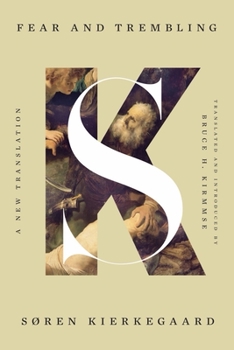
Fear and Trembling: A New Translation

Select Format

Select Condition ThriftBooks Help Icon

Recommended

Format: Paperback

Condition: New

$14.77
Save $3.18!
List Price $17.95
Ships within 24 hours
Save to List

Book Overview

First published in 1843 under the pseudonym Johannes de silentio ("John of Silence"), S ren Kierkegaard's richly resonant Fear and Trembling has for generations stood as a pivotal text in the history of moral philosophy, inspiring such artistic and philosophical luminaries as Edvard Munch, W. H. Auden, Walter Benjamin, and existentialist Jean-Paul Sartre. Now, in our era of immense uncertainty, renowned Kierkegaard scholar Bruce H. Kirmmse eloquently brings this classic work to a new generation of readers.

Retelling the biblical story of the binding of Isaac, Fear and Trembling expounds on the ordeal of Abraham, who was commanded by God to sacrifice his own son in an exceptional test of faith. Disgusted at the self-certainty of his own age, Kierkegaard investigates the paradox underlying Abraham's decision to allow his duty to God to take precedence over his duties to his family. As Kierkegaard's narrator explains, the story presents a difficulty that is not often considered--namely, that after the ordeal is over and Isaac has been spared at the last moment, Abraham is capable of receiving him again and living normally, even joyfully, for the rest of his days. Almost inexplicably, "Abraham had faith and did not doubt."

Deftly tracing the autobiographical threads that run throughout the work, Kirmmse initially, in his lucid and engaging introduction, demystifies Kierkegaard's fictive narrator, Johannes de silentio, drawing parallels between Abraham's willingness to sacrifice his son and the author's personal "sacrifices." Ultimately, however, Kirmmse reveals Fear and Trembling as a fiercely polemical volume, designed to provoke the reader into considering what is actually meant by the word "faith," and whether those who consider themselves "true believers" actually are.

With a vibrancy almost never before seen in English, and "a matchless grasp of the intricacies of Kierkegaard's writing process" (Gordon Marino), Kirmmse here definitively demonstrates Kierkegaard's enduring power to illuminate the terrible wonder of faith.

Customer Reviews

4 ratings

true faith is not completely reliant on logic

The value of this work is that it correctly argues that faith is ultimately a choice that cannot be completely supported by logic or rational proof. It was Kierkegaard's experience of losing the chance to be with the person he loved that forced him to confront the absurd nature of faith. Although believers in many religions will argue that their faith is logical and rational, Kierkegaard fully grasped that if conviction is based fully on logic, it does not need faith to support it. Perhaps the best metaphor can be found in the New Testament passage where Christ invites Peter to walk on water -- Peter takes a step with faith and does not sink, but then looks down, and begins to evaluate the situation using his rational mind, and begins to sink. True faith walks on water. Only true faith could be sufficient to base a life on the conviction that a dead guy in Jerusalem 2,000 years ago came back from the dead and has his own kingdom where his followers will live forever in eternal bliss. On the other hand, this conviction has become so entrenched in the popular culture of the last 2,000 years that it has just become an unremarkable backdrop to the modern world and is considered a socially acceptable belief. The challenge for a modern christian is to find true faith when they mistakenly believe that the story of Jesus Christ is completely supported by logic and rational thinking. The mere act of mentally assenting to what has been accepted in popular culture, a broad and shallow idea that God and Jesus exist, is not faith at all; just an unexamined conclusion of a lazy mind that has not yet questioned its own surroundings. True faith is a radical departure from the status quo, a renewal of personal conviction despite all contradictions and a recognition of UNCERTAINTY. Without a recognition of uncertainty, faith has no meaning. The strength of true faith is that it acknowledges that uncertainty exists, and yet still forges on in spite of the uncertainty, willingly accepting and embracing the consequences of conviction in the face of uncertainty. There is not fear that the conviction may be misled and flinching because of the uncertainty, there is a recognition that this lack of absolute rational proof and certainty is what gives faith its supreme virtue. This is what makes faith courageous and is something that only mortal humans can do, since angels are blessed with absolute knowledge whereas humans are blessed with uncertainty, which is the only way that true freedom can exist. Without this freedom, the choice of "faith" would not be possible, would not be courageous, and would not make mortals eligible for the reward of heaven. The believer who claims that all faith is logical has not yet come to the moment of testing, like Abraham, like Kierkegaard, where the object of the soul's deepest longing and only happiness is seen, but yet out of reach. For Kierkegaard it was the girl he loved, that he could never be with, but yet he

Johannes de silentio is anything but

The ironic pen-name Kierkegaard uses should be more than enough warning that things aren't necessarily what they seem, so if anyone tells you what this book is about, or what Kierkegaard intended, I suggest you take it with a grain of salt, read this book, and decide for yourself.Students of Kierkegaard will tell you the meaning of this book in terms of his personal life; philosophers will show you its philosophical meaning; the religious will describe it as a treatise on faith. It is probably all of these, and may be even more. The work centers on the exemplary life of Abraham, in particular the story in which he is asked by God to sacrifice his beloved son Isaac - the son given to him as fulfillment of a promise by God himself. This story is fully worthy of the "fear and trembling" the title expects, but it also serves as an archetypal example of faith itself, in uncompromising terms.It is also a counter-argument against the (in Kierkegaard's view) stifling moral rationalism of Hegel - an argument "on the strength of the absurd" which is nonetheless compelling, even if one were to ultimately reject it. Considering this, it is perhaps fitting that his work - certainly grave and severe - ultimately provides an affirmation of individual self-determination and a wholehearted engagement with the real world and its affairs... a faith which Kierkegaard professed himself incapable of.Worth the time of reading once or several times. Poetic, but not lighthearted entertainment - then again, who would read a book titled "Fear and Trembling" on a lark?

Makes a philosopher weak in the knees

FEAR AND TREMBLING stands as one of Soren Kierkegaard's most widely read works. It's brevity is appealing to those with only a marginal interest in philosophy and theology. It's subject matter is what attracts those persons who want to find a nexus between ethics and theology.In the work, Kierkegaard engages the famous passage in the Old Testament of the bible where Abraham is ordered by God (Yahweh) to sacrifice his son, Isaac. It stands today as the most salient episode in the bible where Plato's EUTHYPHRO dillema is confronted.Now, what is the EUTHYPHRO dillema, you may ask? The dillema is set out by Socrates in Plato's dialouge of the same name. Basically, it comes down to this: are good and evil intrinsic to the universe itself? Or are the qualities of good and evil decided upon by God (or gods)? If the former is true, then God (or the head of a pantheon of gods) cannot be truly omnipotent, for there is at least one power that even he / she / it must follow. If, on the other hand, good and evil are decided by God(s), then might makes right. Enter Kierkegaard, who spends the pages of this work acting more-or-less as a defense attorney for Abraham for his even contemplating the murder of his son. For Kierkegaard, the divine-command-theorist, the latter horn of the conundrum (i.e.: might makes right) is the only plausible alternative open for the religious believer. The first horn denies God's sovereign omnipotence over the universe and all of its affairs, which is utterly unacceptable.So, the Dane offers to us the defense of what he calls the "teleological suspension of ethics." That is to say, while Abraham was acting out of direction from God, he was not subject to the ethical laws of the "everyday" universe that the rest of us live in every day.That, in brief, is the topic that this book considers. For the complete explanation and polemics of his views, this book is highly recommended. That the subject matter of FEAR AND TREMBLING greatly disturbed Kierkegaard becomes readily obvious in the first pages. If the arguments presented are examined carefully, it is a topic whose implications may very well shock the modern-day theologian as well.

Is Going Beyond Faith Possible?

Kierkegaard first takes issue with the prevailing (i.e., Hegelian) notion that faith is something to be "transcended" by means of systematic philosophy, and almost baits the reader to consider what it means to go "beyond" faith anyway. Next, he postulates 4 thought experiments that (poetically) reconstruct the Abraham and Isaac ordeal, each of which is intended to show how the story might be harmonized with the prevailing Hegelian mode of understanding the "univeral" in ethical terms. Finally, the section on "Problemata" argues against three (at the time well-known) postulates of Hegelian ethical thought by showing that these are all inconsistent with some remarkable feature of the faith that Abraham evidences. The section on the Knight of Infinite Resignation and the Knight of Faith provide, albeit obliquely, support for the view that the movement of faith is absolute, and cannot be transcended.Hannay's introduction is excellent (however, I would suggest first skimming it, then reading Kierkegaard's book, then reading it in earnest at the end).
Copyright © 2026 Thriftbooks.com Terms of Use | Privacy Policy | Do Not Sell/Share My Personal Information | Cookie Policy | Cookie Preferences | Accessibility Statement
ThriftBooks® and the ThriftBooks® logo are registered trademarks of Thrift Books Global, LLC

GoDaddy Verified and Secured