


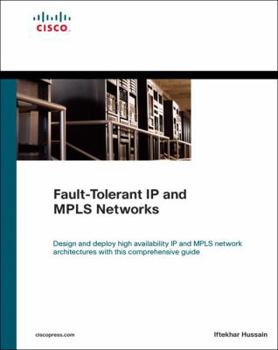
Fault-Tolerant IP And MPLS Networks

Provides you with an in-depth analysis of the mechanisms that improve the reliability and availability of IP and MPLS control plane components. This is a practical guide for understanding, designing,... This description may be from another edition of this product.
Format:Hardcover
Language:English
ISBN:1587051265
ISBN13:9781587051265
Release Date:November 2004
Publisher:Cisco Systems
Length:316 Pages
Weight:0.45 lbs.
Dimensions:9.8" x 1.0" x 7.8"
Customer Reviews
2 ratings
Excellent reference for Cisco high availability
Published by Thriftbooks.com User , 21 years ago
Reviewer: Rik Guyler, Senior Network Engineer Cisco Certifications Held: CCNA, CCDA, CCNP, CCDP Iftekhar Hussain's Fault-Tolerant IP and MPLS Networks is worthy of consideration by anybody that works in a Service Provider environment. This reference, while not a configuration guide by any means, provides insight to the some of the design considerations of a Service Provider network. The things I like about this book: I found this book reasonably easy to read. The information was given in a clear and concise manner without a lot of fluff. With only 316 pages (including index), there was very little written that was not important to the topic. After having read dozens of technical books, this was a refreshing change of pace from the 1000+ page tomes that contain no more real content than this book does. The manner in which the book was written and published was very tidy and neat. It's been rather typical in my experience to find technical books riddled with errors but this book was not. In fact, I cannot recall seeing one error or maybe more accurately, I cannot recall catching one. Either way, this book was cleanly published. I will not go into too much detail about the content as the name of the book speaks for itself. I will say that the content is right on track for what it claims and that provides a realistic look at various fault-tolerant mechanisms and practices designed for the Service Provider network. Not having a foundation in MPLS, I definitely learned where MPLS fits into the big picture with regard to high availability networks. Once again, this book is not a low level technical reference that will guide you to configuring your Cisco routers. It offers strictly a Network Architect's view of the technologies mentioned. The things I do not like about this book: I cannot honestly say that there is much I do not like about this book. I chose this book thinking that there would be more low level technical information such as configuration guidelines for the various technologies so I was somewhat disappointed that there was nothing like this. However, after reading this book, it clearly is a design and concepts book so I would have liked it to have said "Design" only rather than "Design and deploy" on the cover. A picky complaint for sure but valid nonetheless. It is also worthwhile to mention (not a complaint) that while this book includes routing protocols such as BGP, OSPF and ISIS, it does not get into the functionality of these protocols except to discuss how they fit into a high availability design. The same can be said about MPLS. If you want detailed information on BGP, OSPF, ISIS or MPLS then you will need to look to other reference materials. I highly recommend this book for everybody that wishes to learn more about some of the high availability features offered to Service Providers by Cisco.
Stirring the Protocol Soup
Published by Thriftbooks.com User , 21 years ago
This book describes a great many of the common scenarios involved in achieving resiliency in IP/MPLS core networks. With a heavy migration to converged, multiservice IP networks underway, network availability and reliability are extremely critical. Today's IP infrastructure continues to serve the needs of legacy applications along with new service offerings such as VoIP and other premium IP services that are rated based on performance (such as latency, jitter, and carrier-class availability). To deliver value-added IP services that are backed by Service Level Agreements (SLAs), the service provider's network must attain a very high level of service availability. Triple play applications have carrier class requirements that include rigorous uptime requirements more commonly associated with diverse transport networks that may be SONET/SDH supporting ATM or frame relay. Expected of both legacy and emerging applications, these features include nonstop forwarding (NSF), graceful restart (GR), in-service software upgrade (ISSU), bidirectional forward detection (BFD), and traffic engineering (TE) with fast reroute (FRR). Failover times for redirected traffic is expected to be on the order of 50 ms for applications such as broadcast video, and the latency and jitter requirements of voice have only recently been associated with the capabilities of a routed infrastructure such as IP/MPLS. This book illustrates how to integrate these demanding applications into service provider core networks. MPLS is a technology that requires a clean separation of the forwarding and control plane; although earlier routing platforms did not have this separation, modern routers do (interestingly, so does the book!). The control plane can thought of as the routing engine; it maintains peer relationships, runs routing protocols, builds the routing table, and creates the forwarding table, which it then exports to the forwarding plane to send the packets to their output interfaces. After an initial chapter that explains how to design for IP/MPLS uptime, Part I deals with the forwarding planes for both IP and MPLS. The main issue in terms of resiliency here is NSF, which is very important in carrier environments. Software is a common cause of network element failure and it is a huge boon to carriers when a routing platform can forward packets even while the control plane is in trouble. Failure is not an option in the service provider community, because any false step can severely damage a service provider's hard-earned reputation for delivering quality services. Part II covers the IP/MPLS control plane, where IP routing protocols and MPLS signaling protocols are run. The interior routing protocols covered are ISIS and OSPF; these are the most common IGPs for service providers. For these, and in fact for all of the control plane protocols, the issue is how to minimize the effect of a restart on the router's operation. Things get tricky here because Cisco routers m
Copyright © 2026 Thriftbooks.com Terms of Use
| Privacy Policy | Do Not
Sell/Share My Personal Information | Cookie Policy | Cookie Preferences | Accessibility Statement
ThriftBooks® and the ThriftBooks® logo are registered trademarks of Thrift Books Global, LLC
ThriftBooks® and the ThriftBooks® logo are registered trademarks of Thrift Books Global, LLC
