


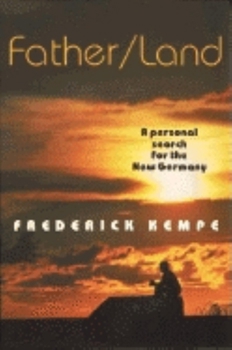
Father/Land: A Personal Search for the New Germany


Select Format
Select Condition 
Book Overview
"A joy to read, in fact, a book so good one doesn't want it to end.... Kempe has written a piece of contemporary history as it should be written, in clear, engaging prose, and with judicious and sensible arguments. He has expertly handled the history of modern Germany, and given us insights into the German soul, including his own, that are crucial for an understanding of our modern world." --Kirkus Reviews "While Kempe does not sugarcoat Germany's current problems-its dyspeptic tolerance of immigrants, its pervasive bureaucracy and pedantry, the viciousness of the neo-Nazis-he argues that young Germans are right to no longer feel guilt for the Holocaust, as long as they learn its lessons." --Newsday "This is a fascinating and important book for anyone interested in the New and Old Germany. Fred Kempe turns in Father/Land to a different land-the mysteries and dark secrets of his German family that lay shrouded since the Third Reich. As painful as it is, this is a search that Kempe could no longer refuse if he was to bring some sense to his American character and German roots. As he interweaves his family's history with that of the German nation, his personal quest becomes a window not only into the German past but also into Germany's future." -Daniel Yergin, Pulitzer Prize-winning author of The Prize "Father/Land takes us on a spellbinding journey into Germany's past and present.... When Kempe finally discovers the horrific story that lies buried in his own family's history, the reader has the shock of experiencing the nightmare of Nazism from the inside." --David Ignatius, columnist, The Washington Post "From a skilled American reporter's search for his German ancestry emerges a rich and rewarding portrait of a nation moving toward a promising future even as it remains tied to an inescapable past." --Ronald Steel, author of Walter Lippmann and the American Century "No foreign correspondent knows Germany as well as Frederick Kempe." --Volker R he, former defense minister of Germany During a pilgrimage to Germany with his father, Fred Kempe promised him he would write about modern Germany. Twelve years later, as a correspondent for The Wall Street Journal Europe, Kempe began a long journey of exploration in an attempt to answer questions that haunted him about his father's land: "How could such an apparently good people with such a rich cultural history have done such evil things? What causes evil, and what breeds good? After only half a century of reeducation and reconstruction, could the strength of German democracy and liberalism be as great as it seemed?" Kempe delves into Germany's demographic change, its modern military, its youth, and America's role in the remaking of Germany after the war. He also looks at German pre-war history and how that history plays into shaping the future of the newly intact Germany. While searching modern Germany for the answers to his philosophical questions, Kempe finds himself in a parallel search for the roots of his own German heritage. Through seeking out relatives and searching documents that might enlighten him about the unspoken mysteries of his family's past, he discovers more than he bargained for, and at the same time learns a great deal about himself. The journey that began as the fulfillment of a promise to his father, led him as he had hoped, to a greater understanding his father's Heimat.
Format:Paperback
Language:English
ISBN:0253215250
ISBN13:9780253215253
Release Date:April 2002
Publisher:Indiana Univ Pr
Length:339 Pages
Weight:1.10 lbs.
Dimensions:8.8" x 0.8" x 6.0"
Customer Reviews
4 ratings
An excellent introduction
Published by Thriftbooks.com User , 22 years ago
I have used this as the closing text in college courses on modern Germany with great success. It captures the nuances of contemporary Germany rather well: a continuing obsession with order and precision, immigration, a fascination with America, reunification, a new generation's coming to grips with a horrific and inescapable past, and learning to exercise a measured assertiveness in a world still wary of German power. To do all this in such a (relatively) small book and nonetheless remain highly readable is an achievement along the lines of Gordon Craig's *The Germans*. The book is hard to beat as an introduction to contemporary Germany.
Gut begonnen ist halb gewonnen (Well begun is half done)
Published by Thriftbooks.com User , 22 years ago
Indeed, Kempe's search provides intrinsic insight into the contemporary, German psyche that avoids historical pedagogy, monotony, and trite narrative. Each chapter reveals its relevance through Kempe's relating of personal, sometimes poignant anecdotes that reveal current issues in German politics and culture. Acknowledging his strong German heritage and personal interest, Kempe takes a critical point-of-view on some of Germany's present/recent past issues: conflicts with the Turks (Germany's largest ethnic minority), Germany's military engagement in Bosnia, etc. However, what truly makes Kempe's work unique is his interweaving of past and present, his personal railing against his Nazi grandfather's heinous crimes and acquittal and praise of modern Germany's informed policies. As Kempe urges and accomplishes himself, the Germans must exact courage in the face of their history and the favorable situation they now find themselves in, for as Geibel once said, "When there is nothing more awesome than fate, it is courage that will bear without a shutter."
German peacekeepers in Bosnia represents a turning point.
Published by Thriftbooks.com User , 26 years ago
Kempe spends time interviewing several different "normal" Germans and reveals the complexity of German life 50 years after the Third Reich. A non-immigration country with a liberal immigration policy and a burgeoning Turkish-German population. A military peacekeeping force in the same land terrorized by Nazis two generations earlier; young soldiers are shocked by the brutality they see around them. This book shatters many of the stereotypes we Americans have about how Germans are, or should be, today. As the descendant of German immigrants, I especially appreciated Kempe's description of his emotions as he gradually uncovered and faced his relative's complicity in Germany's dark legacy. Highly recommended.
A Must-Read for German Americans and American Germans
Published by Thriftbooks.com User , 27 years ago
After ending what was a spell-binding read for me I want to thank Fred Kempe for writing this wonderful book. It will hit the core of anybody who lives in a context that connects the U.S. and Germany.For the most part, the style of the book is very conversational and very enjoyable to read: "a spellbinding journey".Two threads are brilliantly interwoven.There are the author's travels through the re-united Germany (and Bosnia) of the late 90's and his experiences and interchanges with Germans from all parts of society. This is the part of the book that is optimistic, sometimes humerous but never less than deeply analytical and consisely accurate.Then there is the personal quest of Fred Kempe, the reluctant German-American. Denying his German roots for a large part of life, he leads us through his developing interest in his famliy history and finally the very personal confrontation with Germany's horrible past in the context of the author's family. This is a very dark chapter of the book and, appropriately, a haunting read. There is the comparison of the U.S.-German relationship to that of an older and younger brother. In that sense being Fred Kempe's younger brother (born 1955 in Germany and living in the U.S. since 1989), I must say that I like the parts best which describe and characterize post cold-war Germany and the younger generation. The historic perspective is very necessary to understand the 90's but it this "modern" half of the book that makes it unique. It is here where I find myself and my friends back in Germany quoted literally through words and views of people who talked to Fred Kempe. And it is this part of the book that I hope will help the U.S.-German relationship beyond the 1990's.
Copyright © 2026 Thriftbooks.com
Terms of Use | Privacy Policy | Do Not Sell/Share My Personal Information | Cookie Notice | Cookie Preferences | Accessibility Statement
ThriftBooks ® and the ThriftBooks ® logo are registered trademarks of Thrift Books Global, LLC
ThriftBooks ® and the ThriftBooks ® logo are registered trademarks of Thrift Books Global, LLC
