
Skip to content
Scan a barcode
Scan
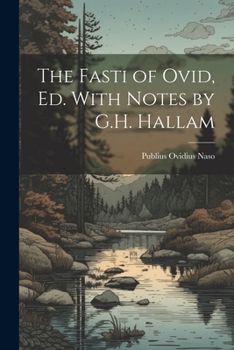
Paperback The Fasti of Ovid, Ed. With Notes by G.H. Hallam Book

ISBN: 1021229318

ISBN13: 9781021229311

The Fasti of Ovid, Ed. With Notes by G.H. Hallam

Select Format

Select Condition ThriftBooks Help Icon

Recommended

Format: Paperback

Condition: New

$26.95
Ships within 2-3 days
Save to List

Book Overview

The Fasti is a six-book poem by the Roman poet Ovid that describes the Roman calendar and the festivals associated with it. It is a fascinating and valuable source of information about ancient Roman religion and culture, and remains widely read today. This edition is edited by GH Hallam and includes detailed notes to help readers navigate the complex historical and cultural context of the poem.

This work has been selected by scholars as being culturally important, and is part of the knowledge base of civilization as we know it.

This work is in the "public domain in the United States of America, and possibly other nations. Within the United States, you may freely copy and distribute this work, as no entity (individual or corporate) has a copyright on the body of the work.

Scholars believe, and we concur, that this work is important enough to be preserved, reproduced, and made generally available to the public. We appreciate your support of the preservation process, and thank you for being an important part of keeping this knowledge alive and relevant.

Customer Reviews

2 ratings

Very well done!

This Penguin edition is very well done and preserves the meaning of the Latin without distorting or mangling it. The book also contains copious and well-researched notes to explain the numerous festivals, minor dieties, and individuals that Ovid mentions. The Fasti is invaluable as a glimpse of Roman culture, not only as a product of the Etruscan influences, but those of the other Italic peoples and the Greeks as well. Ovid skillfully adapts a plethora of "sacred rites unearthed from ancient annals" (1.7-8). What those "sacred annals" contained, we don't know for sure, but many of Ovid's stories included in the poem allude to and are corroborated by the works of Hesiod, Livy, Catullus, Lucretius, Vergil, and others. Ovid however puts his "slant" on things and makes associations that some argue are erroneous. Perhaps. But, taken as a whole, the Fasti is a great poem to also put Roman history into perspective. Ovid again and again stresses Rome's humble beginnings and it's current (for him) preeminence in the world -- "imperium sine fine." A very well done translation of an amazing work that is not widely read in schools.

Counting the days, at "the end of the world"...

This one volume work in the Loeb Classical Series (# 253) isOvid's remarkable combining of poetry, myth, astrology,astronomy, and commentary on Rome. Apparently the work was written, or completed, whileOvid was in exile in what is today Romania (in theancient city of Tomis), having been sent there by theEmperor Augustus. Ovid's life there must have been misery, anguish, andhardship (how different from the famous poet allRome had talked about before his fall!). The poems about that exile, along with letters which he sent backto Rome, can be found in Loeb Classical volume, # 151, -Tristia, Ex Ponto- (ISBN: 0674991672). This present volume "is a poetical treatise on theRoman calendar, which it discusses in chronologicalorder, beginning with the first day of January andending with the last day of June, where it stopsabruptly." (Introduction.) Ovid had intended towrite 12 parts to the work, but we only have thefirst six. The author of the Introduction makes some scholarly speculations about what happened tothe other six parts, which are very interesting. This Loeb version is translated by James G. Frazer,who himself had orginally published a 5-volume editionof the -Fasti-, but trimmed a bit of his scholarlycommentary in order to produce this one-volume editionfor the Loeb series. Frazer (1854 - 1941) was aBritish anthropologist, folklorist, and classicalscholar; his 12 volume opus, -The Golden Bough-,is a world-famous work on comparative ancient religions,myth, and cultural rites. Ovid, himself, was exremely interested not onlyin poetry, but in myth and cultural rites as well. Thatis clearly evidenced in the -Fasti-. Here is an exampleof the combining of poetry, with myth, and astrology/astronomy from March 5: "When from her saffron cheeksTithonous' spouse shall have begun to shed the dew /at the time of the fifth morn, the constellation,whether it be the Bear-ward or the sluggard Bootes, will have sunk and will escape thy sight. But notso will the Grape-gatherer escape thee." There ismore to the quote which expands on the myth of theorigin of the constellation. There are excellentnotes to explain allusions, as well as a scholarlyIntroduction to the volume. Though Ovid was trying to find some way to gaineither commutation or release from his exile, he wasnot successful (either under Augustus or his successor,the Emperor Tiberius). Still, though seeking clemency,Ovid nonetheless takes satiric swipes at Rome'slosing of ancient values. Ovid died in exile andwas buried in Tomis. "Sic transit gloria mundi." -- Robert Kilgore.
Copyright © 2026 Thriftbooks.com Terms of Use | Privacy Policy | Do Not Sell/Share My Personal Information | Cookie Policy | Cookie Preferences | Accessibility Statement
ThriftBooks ® and the ThriftBooks ® logo are registered trademarks of Thrift Books Global, LLC

GoDaddy Verified and Secured