


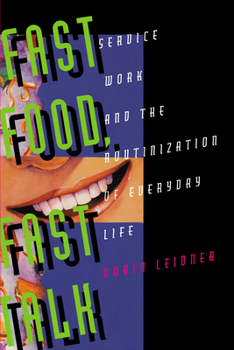
Fast Food, Fast Talk: Service Work and the Routinization of Everyday Life


Select Format
Select Condition 
Book Overview
Attending Hamburger University, Robin Leidner observes how McDonald's trains the managers of its fast-food restaurants to standardize every aspect of service and product. Learning how to sell life insurance at a large midwestern firm, she is coached on exactly what to say, how to stand, when to make eye contact, and how to build up Positive Mental Attitude by chanting "I feel happy! I feel terrific!"
Leidner's fascinating report from the frontlines of two major American corporations uncovers the methods and consequences of regulating workers' language, looks, attitudes, ideas, and demeanor. Her study reveals the complex and often unexpected results that come with the routinization of service work.
Some McDonald's workers resent the constraints of prescribed uniforms and rigid scripts, while others appreciate how routines simplify their jobs and give them psychological protection against unpleasant customers. Combined Insurance goes further than McDonald's in attempting to standardize the workers' very selves, instilling in them adroit maneuvers to overcome customer resistance.
The routinization of service work has both poignant and preposterous consequences. It tends to undermine shared understandings about individuality and social obligations, sharpening the tension between the belief in personal autonomy and the domination of a powerful corporate culture.
Richly anecdotal and accessibly written, Leidner's book charts new territory in the sociology of work. With service sector work becoming increasingly important in American business, her timely study is particularly welcome.
Leidner's fascinating report from the frontlines of two major American corporations uncovers the methods and consequences of regulating workers' language, looks, attitudes, ideas, and demeanor. Her study reveals the complex and often unexpected results that come with the routinization of service work.
Some McDonald's workers resent the constraints of prescribed uniforms and rigid scripts, while others appreciate how routines simplify their jobs and give them psychological protection against unpleasant customers. Combined Insurance goes further than McDonald's in attempting to standardize the workers' very selves, instilling in them adroit maneuvers to overcome customer resistance.
The routinization of service work has both poignant and preposterous consequences. It tends to undermine shared understandings about individuality and social obligations, sharpening the tension between the belief in personal autonomy and the domination of a powerful corporate culture.
Richly anecdotal and accessibly written, Leidner's book charts new territory in the sociology of work. With service sector work becoming increasingly important in American business, her timely study is particularly welcome.
Format:Paperback
Language:English
ISBN:0520085000
ISBN13:9780520085008
Release Date:August 1993
Publisher:University of California Press
Length:278 Pages
Weight:0.97 lbs.
Dimensions:0.8" x 6.0" x 9.0"
Customer Reviews
2 ratings
Engaging book, debateable premise
Published by Thriftbooks.com User , 19 years ago
When all is said and done, American consumers are more alike than they are different. This truth of human psychology provides the bedrock of our mass production economy; it is possible to create core products that millions of people will buy, and it is possible to design methods of presontation and marketing that millions of people will respond to. Consistancy beats creativity. That said, individuals, even those who aren't considered wildly creative or in any way eccentric still need to shave off 5 - 10% of their personalities to find their fit in cultures devoted to providing a consistant product or approach to business. Dr. Leidner's study of how this morphing of individual to group collective focuses on two job classes at diverse ends of the American economic experience. On the one side is McDonalds, whose counter and burger flipping positions, even if in many instances filled by students on their way to something far different, have also become a shorthand for employment of last resort among those with few skills, options, and long term prospects. On the other end of the study is Combined Insurance Company of America (CICA), a subsidiary of Aon Corp. CICA is a sales driven company, and sales - dispite the field's high washout rate - remains for those who do it well the highest paying profession in America. Early on Dr. Leidner suggests that there is irony in the fact that these companies, which rely on structure and standardization to a degree uncommon in their respective fields, were formed by highly dynamic individualists, Ray Krock and W. Clement Stone respectively, who challenged convention and relied on personal instinct in building their empires. It makes for a nice sentence or two, but most people who build empires, be they Krock and Stone, or Henry Ford, Andrew Carnegie, James Hill, Michael Dell, Sam Walton, etc use a different approach to building than will subsiquently be needed to maintain and expand those companies. Even a company as wildly creative as Apple Computer needs to instill a degree of structure within the organization if only so it doesn't fall prey to entrophy. Still, organizational struture isn't the theme of the book, instead it is what happens to people whose jobs involve working directly with customers, human interactions, that realm of life where individual personality is most apt to express itself, but who are told to conduct those exchanges with the same routine and scripting of a working standing at a machine and mass producing parts on an assembly line. Because McDonalds is a recognizeable American icon most of the attention given this book - including the other review on this site - focuses on the chapters dealing with the fast food giant. I found the chapters about Combined Insurance Company far more interesting. I work in sales and during my second year in the field I joined (and have since left) CICA in Virginia during the time that Leidner was doing her research and observations in the company's mid
A Prophecy Fulfilled?
Published by Thriftbooks.com User , 24 years ago
Hungry and tired of the banality of couscous, hara (a tomato based soup) and tajine that I had been eating in Morocco for the past four months, I burst through the doors of one of the McDonald's in the city of Casablanca. I was on a mission. I had dragged several of my friends by train, bus, taxi, and foot for the singular purpose of eating a Big Mac. I was feed up. I needed food that I could trust to be produced in some standardized fashion, that would be clean and well cooked. I also needed to use a bathroom that was clean. This "quest" occurred during a foreign exchange to Morocco during the fall of 2000. But the story begins much earlier perhaps in 1994 when I was 12 or 13. My father had taken me to our local Borders bookstore in the suburbs of Philadelphia to hear a lecture about McDonald's of all things (I was home schooled at the time and going to lectures such as these was a continual part of my education). Robin Leidner's lecture was probably my first exposure to sociology and I believe one of the causes that lead to a radical shift in my adolescent thinking. Never again was the world the same. In a sense, Robin Leidner gave birth to my "sociological imagination." Ever since I have also been fascinated by McDonald's as an indicator of American culture. There is something awe inspiring about the success of McDonald's and its guarantee of a certain quality of food, cheer, and service no matter where in the world I should travel. (The phenomonem of McDonald's seems reminscent of something one might find in a dystopian post-industrial science ficiton story.) That at, one time, 7% of US workers had worked at McDonald's at one time or another, speaks to the influence of McDonald's in the lives of Americans. On the other hand, the routinization that has been key to McDonald's success raises questions of alienation, autonomy and robotization of employees for the sake of profit. Ever present is the conflict between self-identity and existence in a corporate world that requires all things to be standerdized. Dr. Leidner provides insight into corporate culture that many of us will at sometime or another participate in. It would be good judgment to know what we are getting ourselves involved in. I, for one, have learned to appreciate the significance of McDonald's organizational structure, while being cogent of the impact of its corporate values on the individual and society. There is a sense of empowerment in "decoding" society and locating ones position in society and it is my hope that others, outside of academia, will read Leidner's book and become consciouse of their organizational context. There is the sense of a prophecy fulfilled. After first seeing Dr. Leidner and reading of the expansion of McDonald's to Morocco, I have, seven years later eaten at the first McDonald's in Morocco, always with "Fast Food, Fast Talk" in mind. The impetus for this has always been to see for myself if Dr. Leidner was right: could McDonald's really be the s
Copyright © 2026 Thriftbooks.com Terms of Use
| Privacy Policy | Do Not
Sell/Share My Personal Information | Cookie Policy | Cookie Preferences | Accessibility Statement
ThriftBooks® and the ThriftBooks® logo are registered trademarks of Thrift Books Global, LLC
ThriftBooks® and the ThriftBooks® logo are registered trademarks of Thrift Books Global, LLC
