


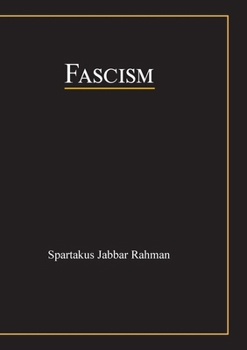
Fascism
No Customer Reviews

With the rise of new populist movements, a number of contemporary ideologies have been wrongly associated with Fascism. Over the past decades Fascism itself has been repeatedly redefined. Many current definitions no longer identify a specific historical doctrine. They reduce Fascism to a loose set of methods, organisation, mobilisation, hierarchical leadership and state direction, that can be applied with equal ease to socialism, nationalism, developmental dictatorships and almost any other political formation of the nineteenth and twentieth centuries. Once the term is stretched this far it loses analytical value and becomes a political label rather than a historical category. This book adopts a different approach. It follows the ideological development of Fascism in the order in which it actually took shape, relying primarily on contemporary texts, laws and programmes in order to understand its foundations.The account traces the successive economic, philosophical and political currents that were selectively absorbed and transformed into a coherent doctrine. It examines the formation of the Fascist state, the organisation of production under public authority, and the internal variations that produced distinct types within the same matrix. The concluding section marks the boundaries of the phenomenon by distinguishing it from neighbouring formations that share certain surface features while resting on different principles.Drawing throughout on primary sources, the book sets economic arrangements, philosophical claims and political institutions in historical sequence without imposing a single retrospective definition.
Format:Paperback
Language:English
ISBN:3949616101
ISBN13:9783949616105
Release Date:August 2026
Publisher:European Centre for Middle East Studies
Length:138 Pages
Weight:0.35 lbs.
Dimensions:8.3" x 0.3" x 5.8"
Customer Reviews
0 rating
Copyright © 2026 Thriftbooks.com
Terms of Use | Privacy Policy | Do Not Sell/Share My Personal Information | Cookie Policy | Cookie Preferences | Accessibility Statement
ThriftBooks ® and the ThriftBooks ® logo are registered trademarks of Thrift Books Global, LLC
ThriftBooks ® and the ThriftBooks ® logo are registered trademarks of Thrift Books Global, LLC
