


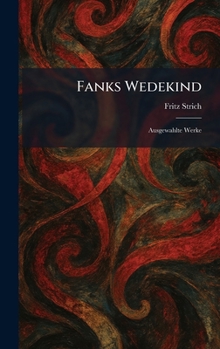
Fanks Wedekind: Ausgewahlte Werke

"Fanks Wedekind: Ausgewahlte Werke" presents a definitive selection of works by one of the most provocative and revolutionary figures in German literature. Edited by Fritz Strich, this collection brings together the essential dramas, poems, and prose of Frank Wedekind, whose radical departure from 19th-century naturalism paved the way for Modernism and Expressionism.
The work focuses on Wedekind's intense exploration of social hypocrisy, human sexuality, and the struggle of the individual against restrictive societal norms. Included are highlights from his dramatic repertoire, such as the "Lulu" cycle and "Spring Awakening", which remain cornerstones of the theatrical avant-garde. Wedekind's writing is characterized by its sharp satire, psychological intensity, and a relentless desire to expose the hidden realities of the human condition.
This volume serves as a vital record of Wedekind's artistic vision, offering readers a comprehensive look at the stylistic diversity and intellectual depth of an author who fundamentally reshaped the landscape of modern theater. "Fanks Wedekind: Ausgewahlte Werke" is an indispensable resource for those seeking to understand the evolution of the dramatic arts and the cultural critique of the early 20th century.
This work has been selected by scholars as being culturally important, and is part of the knowledge base of civilization as we know it. This work was reproduced from the original artifact, and remains as true to the original work as possible. Therefore, you may see the original copyright references, library stamps (as most of these works have been housed in our most important libraries around the world), and other notations in the work.
This work is in the public domain in the United States of America, and possibly other nations. Within the United States, you may freely copy and distribute this work, as no entity (individual or corporate) has a copyright on the body of the work.
As a reproduction of a historical artifact, this work may contain missing or blurred pages, poor pictures, errant marks, etc. Scholars believe, and we concur, that this work is important enough to be preserved, reproduced, and made generally available to the public. We appreciate your support of the preservation process, and thank you for being an important part of keeping this knowledge alive and relevant.
Related Subjects
Drama Literary Literary Criticism & Collections Literature Literature & Fiction PoetryCustomer Reviews
ThriftBooks ® and the ThriftBooks ® logo are registered trademarks of Thrift Books Global, LLC
