


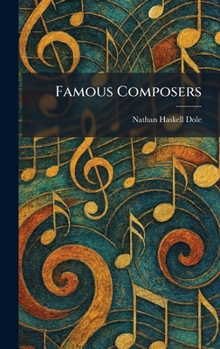
Famous Composers

Select Format
Select Condition 
Book Overview
"Famous Composers" by Nathan Haskell Dole offers a comprehensive and engaging exploration of the lives and legacies of the world's most influential musical geniuses. Written with both the student and the music lover in mind, this collection provides detailed biographical sketches that trace the artistic evolution and personal journeys of legendary figures such as Bach, Handel, Mozart, Beethoven, and Wagner.
Dole's narrative goes beyond mere dates and facts, capturing the essence of each composer's unique contribution to the evolution of harmony, melody, and form. By examining the social and historical contexts in which these masters lived, the work illuminates how their environment shaped their groundbreaking masterpieces. From the sacred choral works of the Renaissance to the sweeping romanticism of the nineteenth century, "Famous Composers" serves as an essential guide to the history of Western classical music.
This work remains a valuable resource for anyone seeking to understand the human stories behind the scores. Whether discussing the technical innovations of keyboard virtuosos or the grand scale of operatic drama, Nathan Haskell Dole presents a vivid portrait of the creative spirit that continues to inspire performers and audiences worldwide.
This work has been selected by scholars as being culturally important, and is part of the knowledge base of civilization as we know it. This work was reproduced from the original artifact, and remains as true to the original work as possible. Therefore, you may see the original copyright references, library stamps (as most of these works have been housed in our most important libraries around the world), and other notations in the work.
This work is in the public domain in the United States of America, and possibly other nations. Within the United States, you may freely copy and distribute this work, as no entity (individual or corporate) has a copyright on the body of the work.
As a reproduction of a historical artifact, this work may contain missing or blurred pages, poor pictures, errant marks, etc. Scholars believe, and we concur, that this work is important enough to be preserved, reproduced, and made generally available to the public. We appreciate your support of the preservation process, and thank you for being an important part of keeping this knowledge alive and relevant.
Customer Reviews
ThriftBooks ® and the ThriftBooks ® logo are registered trademarks of Thrift Books Global, LLC
