


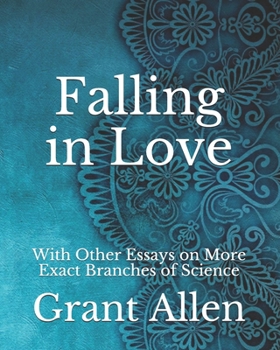
Falling in Love: With Other Essays on More Exact Branches of Science
No Customer Reviews

An ancient and famous human institution is in pressing danger. Sir George Campbell has set his face against the time-honoured practice of Falling in Love. Parents innumerable, it is true, have set their faces against it already from immemorial antiquity; but then they only attacked the particular instance, without venturing to impugn the institution itself on general principles. An old Indian administrator, however, goes to work in all things on a different pattern. He would always like to regulate human life generally as a department of the India Office; and so Sir George Campbell would fain have husbands and wives selected for one another (perhaps on Dr. Johnson's principle, by the Lord Chancellor) with a view to the future development of the race, in the process which he not very felicitously or elegantly describes as 'man-breeding.' 'Probably, ' he says, as reported in Nature, 'we have enough physiological knowledge to effect a vast improvement in the pairing of individuals of the same or allied races if we could only apply that knowledge to make fitting marriages, instead of giving way to foolish ideas about love and the tastes of young people, whom we can hardly trust to choose their own bonnets, much less to choose in a graver matter in which they are most likely to be influenced by frivolous prejudices.' He wants us, in other words, to discard the deep-seated inner physiological promptings of inherited instinct, and to substitute for them some calm and dispassionate but artificial selection of a fitting partner as the father or mother of future generations.Now this is of course a serious subject, and it ought to be treated seriously and reverently. But, it seems to me, Sir George Campbell's conclusion is exactly the opposite one from the conclusion now being forced upon men of science by a study of the biological and psychological elements in this very complex problem of heredity. So far from considering love as a 'foolish idea, ' opposed to the best interests of the race, I believe most competent physiologists and psychologists, especially those of the modern evolutionary school, would regard it rather as an essentially beneficent and conservative instinct developed and maintained in us by natural causes, for the very purpose of insuring just those precise advantages and improvements which Sir George Campbell thinks he could himself effect by a conscious and deliberate process of selectio
Format:Paperback
Language:English
ISBN:B093B9Y2CX
ISBN13:9798743198993
Release Date:January 1
Publisher:Independently Published
Length:226 Pages
Weight:1.01 lbs.
Dimensions:0.5" x 8.0" x 10.0"
Customer Reviews
0 rating
Copyright © 2026 Thriftbooks.com Terms of Use
| Privacy Policy | Do Not
Sell/Share My Personal Information | Cookie Policy | Cookie Preferences | Accessibility Statement
ThriftBooks® and the ThriftBooks® logo are registered trademarks of Thrift Books Global, LLC
ThriftBooks® and the ThriftBooks® logo are registered trademarks of Thrift Books Global, LLC
