


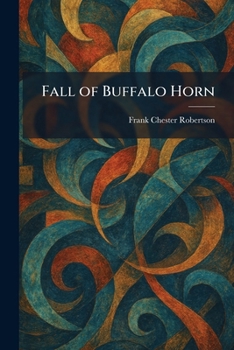
Fall of Buffalo Horn

"Fall of Buffalo Horn" is a gripping Western adventure that transports readers to the heart of the American frontier during a time of intense cultural and territorial conflict. Drawing upon historical events, Frank C. Robertson weaves a narrative centered on the legendary Bannock leader, Buffalo Horn, and the events leading to the Bannock War of 1878. The work captures the raw intensity of the era, portraying the challenges faced by both settlers and Indigenous peoples as the expansion of the United States reshaped the landscape of the West.
The novel combines fast-paced action with a deep sense of place, illustrating the rugged beauty and inherent dangers of the wilderness. Through its exploration of leadership, duty, and the tragic consequences of cross-cultural misunderstanding, "Fall of Buffalo Horn" stands as a classic example of Western storytelling. Robertson's expertise in the genre is evident in his detailed characterizations and atmospheric prose, making this an essential read for those interested in the history and mythology of the American West. This narrative provides not only entertainment but also a literary reflection on a pivotal moment in American history.
This work has been selected by scholars as being culturally important, and is part of the knowledge base of civilization as we know it. This work was reproduced from the original artifact, and remains as true to the original work as possible. Therefore, you may see the original copyright references, library stamps (as most of these works have been housed in our most important libraries around the world), and other notations in the work.
This work is in the public domain in the United States of America, and possibly other nations. Within the United States, you may freely copy and distribute this work, as no entity (individual or corporate) has a copyright on the body of the work.
As a reproduction of a historical artifact, this work may contain missing or blurred pages, poor pictures, errant marks, etc. Scholars believe, and we concur, that this work is important enough to be preserved, reproduced, and made generally available to the public. We appreciate your support of the preservation process, and thank you for being an important part of keeping this knowledge alive and relevant.
Customer Reviews
ThriftBooks ® and the ThriftBooks ® logo are registered trademarks of Thrift Books Global, LLC
