


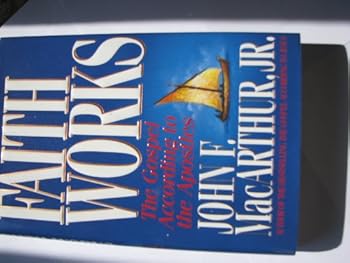
Faith Works: The Gospel According to the Apostles


Select Format
Select Condition 
Book Overview
Faith Works: The Gospel According to the Apostles This description may be from another edition of this product.
Format:Hardcover
Language:English
ISBN:0849908418
ISBN13:9780849908415
Release Date:January 1993
Publisher:W Pub Group
Length:272 Pages
Weight:1.21 lbs.
Dimensions:9.5" x 1.3" x 6.5"
Customer Reviews
5 ratings
Cross-eyed the right way!
Published by Thriftbooks.com User , 17 years ago
The one-star reviewer below could not be more mistaken. John MacArthur does not add legalism to grace as a requirement for salvation. He does, however, combat the popular notion that one simply has to say a "sinner's prayer" to be saved. If all you do is say a sinner's prayer and attend a church that has a "practical" message every week, you may well think that you are saved simply because one time you said, "Lord, Lord" but you can say "Lord, Lord" all the way to Hell and that IS in the Bible. (Read Matthew 7). The sad and simple truth is that in our selfish society with our microwave mentality (I want it fresh, I want it hot, I want it now, and I don't want to wait or work for it), easy-believism is the great apostasy of the modern church. Oh, sure, there are plenty of other heresies and apostasies running rampant, but the wide gate that is ushering the most people into the pit in our day and age is the one whose sign reads "cheap grace". An unrepentant and unregenerate soul may "claim the Name", but the truth of the matter is that if the old man does not die, there is no "new creation". (2 Corinthians 5:17) The Apostle Paul never said that mere obedience to the law could ever say anyone. He argued irrefutably that any who sought their salvation in the law were damned. (See Romans 1-16. And the rest of his epistles). However, I can not find in any epistle the Apostle Paul ever wrote that gives any indication that someone who continues in sin after being called by Christ is destined for salvation. Nor in Peter's, nor in John's or James', and certainly not in Jesus own words. And the evidence of grace in those great mens' lives were the works that were accomplished through "bondservice" to THE LORD. If you really read the four gospels and compare what Jesus actually said and taught about Himself, you would see that John MacArthur does not twist or distort anything. In fact, I don't think that someone coming to the gospels for the first time and actually reading them for themselves--without any preconceptions or preconditioned ideas--would find anything there that seems to suggest that all one has to do is call on the Name of Jesus to be saved. True believers experience a changed life. Jesus said that by their fruit you would know them, and that a bad tree does not produce good fruit; nor a good tree, bad fruit. James, the Lord's brother said that faith without works was dead, just the same as works without faith is dead. The problem is that some modern teachers want to separate works and faith (and grace) as if they could be approached independent of one another. However, I dare say that those three things are no more separable than the three persons of The Trinity! While it would seem absolutely ludicrous for most Christians to invalidate any one or combination of the Father, the Son, and the Holy Spirit, there are yet many who seem to think that faith, works, and grace can be separated and dealt with distinctly as conc
The best single book on the so-called "lordship" debate
Published by Thriftbooks.com User , 23 years ago
This is the follow-up to MacArthur's widely acclaimed first contribution to the debate, "The Gospel According to Jesus" (hereafter TGAJ). This current book seems to present a more careful reflection on the essential aspects of this debate than TGAJ exhibits.It begins with a helpful primer on the "lordship salvation" controversy, where MacArthur correctly identifies the relationship between repentance and conversion as the single most important issue in this controversy. No-lordship proponents assert that there is no necessary relationship between repentance (defined as purposing to turn from sin) and salvation, while lordship proponents aver that repentance is an essential component of the gospel message (Mk 1:14-15; Lk 24:45; Acts 3:19; 11:18; 20:21; 26:20). The startling implication from the no-lordship conception of conversion in this matter is that a sinner may intellectually believe the facts of the gospel for salvation while concurrently harboring hatred and rebellion against Christ in his/her heart!MacArthur also discusses the misrepresentation of the debate often made by no-lordship proponents, who frame the debate in terms that make it appear that the debate is ultimately over salvation by grace alone versus salvation by grace plus works (hence their inaccurate characterization of themselves as "free-grace" advocates). What most no-lordship advocates fail to note in their discussion of the debate is that proponents of lordship salvation conceive of God's saving grace as sovereign and dynamic. Proponents of lordship-salvation conceive of God's salvific grace as effecting not only the salvation of a sinner from the consequences of sin, but also from its tyranny and rule in his/her life. They assert that God's grace not only saves, but transforms. Therefore, when God saves a sinner, He not only brings him/her to an intellectual conviction about the saving ministry of Christ, but also to repentance and submission (in varying degrees) to the lordship of Christ. It appears (from the literature coming forth from the no-lordship camp) that they simply do not understand this essential consideration of the debate. Until they demonstrate an awareness of how lordship proponents conceive of God's grace (i.e. as sovereign and dynamic) the debate will continue to flounder and the proponents will continue to speak past one another.MacArthur also discusses the nature of saving faith, discussing (in chapters 3 and 9) the nature and result of the faith that saves and the character of faith that does not save. No-lordship advocates assert that saving faith is simple intellectual conviction about Jesus Christ as having secured one's eternal destiny (as of late, many no-lordship advocates are even averring that knowledge of Christ's substitutionary work on the cross is not necessary for salvation - consult the Fall 2000 issue of the Journal of the Grace Evangelical Society for documentation). Lordship salvation conceives of saving faith as composed
Lord and Savior
Published by Thriftbooks.com User , 25 years ago
I think MacArthur does a quality job of explaining the Gospel and pointing out that Jesus Christ has to be both Lord and Savior. Intellectualizing the facts of Jesus does not get it done and the doctrine of cheap grace has many people building their house on sand. The gentleman from Dallas should also reference 1 John 2:6 and James 2:17-22. Scripture is meant to be used as one doctrine not separate.
Mac Rightly Divides the Word of Truth
Published by Thriftbooks.com User , 26 years ago
If ever a book was needed to untangle the complete mess made by so-called "evangelicals" of this day with their "easy-believism" it is this one. Rev. MacArthur so meticulously illustrates the concept of Faith and Works that a person would have to be totally spiritually blind not to see it. Modern Christendom has been made a joke by the "no-lordship" propensity of popular ministers and this "doctrine of devils" puts in jeopardy anyone who follows its objectives. For as Jesus said, "Why do you call me Lord and do not the things that I say." Faith without works is dead; genuine faith is made manifest, is proven by the works that flow from it.Dr. MacArthur makes clear that a believer is in no way saved by any meritorious works, but that if a believer is saved "you will know a tree by the fruit it bears." He takes a bad rap from those who want to make the Gospel of Jesus Christ conform to their ideas, instead of being conformed to the Gospel. But then again does not the Bible say that "all that will live Godly in Christ shall suffer persecution?"
If He is not Lord, He is not the Savior.
Published by Thriftbooks.com User , 28 years ago
Having read and studied the Holy Scriptures, it is virtually impossible for me to envision an abomination of such monumental proportions, yet it appears that there exists a not insignificant number of professing Christians who have arrived at the erroneous and blatantly wicked conclusion that Christ may be permitted to become one's Savior while being denied the equally efficacious and indivisible dignity of Lord. In other words, in order to insure eternal salvation and a heavenly reservation one needs but believe, via intellectual assent, the truth of the Gospel (at least that portion relating to Christ as the Son of God and, therefore, the sole means of a soul's salvation), and that person may continue to live a life devoted to self and sin by chronically indulging the passions and lusts of the flesh. If ever a doctrine was spawned in the deepest, darkest abyss of Hell, it is the "no-lordship" theology; a theology that has existed under one guise or another for untold centuries by perpetuating the fraud that God is, indeed, divisible: one may freely select to believe in Christ, thereby guaranteeing a comfortable afterlife, while living a fleshly life of wanton excess, if not absolute and utter evil, upon this earth. The fruit may be most rotten and foul, yet the tree from which it grows deemed good and worthy of salvage. In his book, Faith Works: The Gospel According to the Apostles, John F. MacArthur, Jr. offers a detailed and comprehensive analysis of the "no-lordship" theology and proficiently refutes, via the Word of God, each tenuous strand of this heretical web. In addition to effectively dismantling the fallacious arguments and creeds employed to devise this iniquitous scheme, MacArthur's book is, from cover-to-cover, a superb exposition of the salvation message as contained within the teachings of Jesus Christ and, subsequently, the Apostles. It is the identical message that has been preached since the founding of the one true Church, yet, seemingly, misunderstood by countless multitudes who dislike "deny[ing] self and following [Christ]." If Jesus Christ is to be your Savior, you may be assured that you will accept no other as Lord, including self. There can be only One, and that One is Jesus Christ.
Copyright © 2026 Thriftbooks.com Terms of Use
| Privacy Policy | Do Not
Sell/Share My Personal Information | Cookie Policy | Cookie Preferences | Accessibility Statement
ThriftBooks® and the ThriftBooks® logo are registered trademarks of Thrift Books Global, LLC
ThriftBooks® and the ThriftBooks® logo are registered trademarks of Thrift Books Global, LLC
