
Skip to content
Scan a barcode
Scan
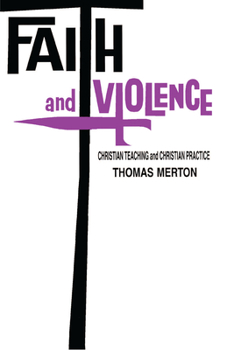
Paperback Faith and Violence: Theology Book

ISBN: 0268000948

ISBN13: 9780268000943

Faith and Violence: Theology

Select Format

Select Condition ThriftBooks Help Icon

Recommended

Format: Paperback

Condition: Acceptable

$7.89
Save $22.11!
List Price $30.00
Almost Gone, Only 4 Left!
Save to List

Book Overview

Merton's classic Faith and Violence makes a powerful case for a theology of resistance that speaks with enduring urgency.

Violence in the modern world is a complex matter. The majority of the world's most egregious acts of violence are not perpetrated at the level of the individual--rather, they occur at the hands of systematically organized bureaucracies. It is this "white-collar" violence that Merton addresses in Faith and Violence. Writing at the height of the Vietnam war, Merton masterfully illustrates the disastrous consequences of wielding and promoting violence. As an alternative, he proposes that Christians retrieve and embody a conception of love that seeks to win over one's adversaries as collaborators rather than crushing or humiliating them. Merton's poignant reflections deal with issues ranging from the Vietnam War to the civil rights movement and the mid-20th century Death of God movement.

Customer Reviews

3 ratings

"This is the Greatest Treason, to Do the Right Thing for the Wrong Reason"

Borrowing from many of the great authors and their existential views, Merton has written a startling collection of essays in "Faith and Violence". Broken into war, civil rights, and "God is Dead", Merton analyzes the Christian faith as he saw it the 1960's. More than forty years later, Merton's themes still shout the truth for all to hear. As I read this, no section struck a deep chord with me more than the essays on war. While he was focusing on the Vietnam War, the concepts apply to the war of today. As quoted in the title of my review for Merton's T.S. Elliot reference, the greatest crime is to mislead a group into conflict. There is no more dangerous cult than nationalism. Violence and war are difficult to justify in any means. Merton spends significant time discussing non-violent resistance. Long before Gandhi employed such tactics, Jesus was using them. In the section on civil rights, Merton suggests that the worst a Christian could do is be a by-stander. The theme of nonviolent resistance is revisited but from a different perspective. After seeing a country employ violence as a solution in Vietnam, could the civil rights be noticed through lesser means? Modeling is a powerful teacher. I would strongly encourage fans of Merton to purchase a copy of this book. I chose not rehash entire parts of the book in my review as Merton makes his statements better than I ever could. I encourage you to discover what Merton had to say in its full context.

, Abusive Behavior in the name of the State?

A good Lutheran friend recommended this book many years ago during a conversation in which he noted "evil must stop with the individual." After reading this collection of essays I better understood his point, especially given his profession in law enforcement - that is to say, as a representative of "the State," and thus "Caesar." As Merton makes clear, violence, requires paticipants throughout all levels of a community. The themes which run throughout Merton's essays read like the front page of any metropolitain newspaper today or 80 years ago. Only, unlike the front page, Merton gently, and at other times without restraint, hammers the reader's established moral compass, challenging the conscience. Cognative dissonance, propaganda, ideology and smiling lies, are examined in relation to the individual's choice to either (often standing alone), refuse, or to participate, in brutal control, supression, degradation or ahnihilation of others.Orwell offers in the novel 1984 that the future of humanity might possibly be an ever present boot, and inherent pain, upon the face of the individual. Anthony Burgess, in A Clockwork Orange, provides a scenario in which this future is all too gladly embraced. Thomas Merton warns that the foot in that boot might very well be our own. At one point he asks the reader to consider: "What will our answer be when pain comes to examine us?" Though Merton has been criticized of late in some circles for having not privately lived by the letter of the law in regard to monastic life and its inherent obligations, his perspective as to what makes evil tick, and challenge to not become a willing, if not active participant, should not be dismissed. No disciple has ever been without blemish. More than a few readers may find themselves telling others about this book - perhaps more now than when first published in the 1960's.

An essential testament by a 20th century prophetic voice

"Faith and Violence: Christian Teaching and Christian Practice" is an excellent collection of essays by Thomas Merton. The essays in this book reflect a turbulent era: the late 1960s (Merton's preface is dated 1967).Merton has a progressive, open-minded Christian vision. He writes about nonviolence, the Vietnam War, the Black Power movement, and "Death-of-God" theology. Interesting specific pieces include articles on the prison meditations of Jesuit Alfred Delp (who was persecuted by the Nazis), on Buddhist monk Thich Nhat Hanh ("my brother"), and on the "Autobiography of Malcolm X" ("a book of decisive importance"). Particularly powerful is his critique of "American Christian rightism," which, he writes, is "a mystique of violence, of apocalyptic threats, of hatred, and of judgment" (in "Religion and Race in the United States").This is a book that every Christian (and many of other belief systems) should read. Merton is an excellent writer, and his ideas remain compelling.
Copyright © 2026 Thriftbooks.com Terms of Use | Privacy Policy | Do Not Sell/Share My Personal Information | Cookie Policy | Cookie Preferences | Accessibility Statement
ThriftBooks® and the ThriftBooks® logo are registered trademarks of Thrift Books Global, LLC

GoDaddy Verified and Secured