


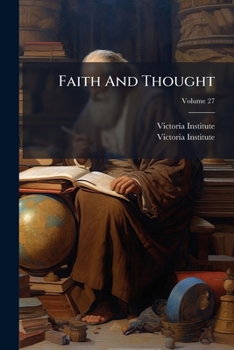
Faith And Thought; Volume 27

Select Format
Select Condition 
Book Overview
Faith and Thought, Volume 27, presents a collection of essays and discussions from the Victoria Institute, a British learned society founded in 1865 to examine the relationship between science and Christian faith. This volume captures the intellectual climate of the late 19th and early 20th centuries, showcasing debates and perspectives on the compatibility of scientific advancements and religious beliefs. Exploring topics ranging from geological discoveries to philosophical inquiries, the contributors offer diverse viewpoints on the intersection of faith and reason.
The collection provides valuable insights into the historical context of science and religion, reflecting the ongoing dialogue between these domains. It offers a window into the intellectual struggles and harmonies sought by Victorian thinkers as they navigated the complexities of a rapidly changing world. Researchers and readers interested in the history of science, Christian apologetics, and the interplay of faith and reason will find this volume a fascinating resource.
This work has been selected by scholars as being culturally important, and is part of the knowledge base of civilization as we know it. This work was reproduced from the original artifact, and remains as true to the original work as possible. Therefore, you will see the original copyright references, library stamps (as most of these works have been housed in our most important libraries around the world), and other notations in the work.
This work is in the public domain in the United States of America, and possibly other nations. Within the United States, you may freely copy and distribute this work, as no entity (individual or corporate) has a copyright on the body of the work.
As a reproduction of a historical artifact, this work may contain missing or blurred pages, poor pictures, errant marks, etc. Scholars believe, and we concur, that this work is important enough to be preserved, reproduced, and made generally available to the public. We appreciate your support of the preservation process, and thank you for being an important part of keeping this knowledge alive and relevant.
Customer Reviews
ThriftBooks ® and the ThriftBooks ® logo are registered trademarks of Thrift Books Global, LLC
