


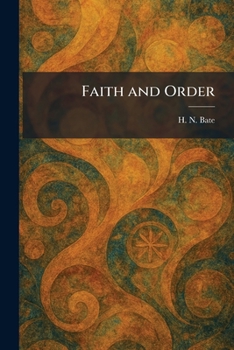
Faith and Order

Select Format
Select Condition 
Book Overview
"Faith and Order" is a significant theological and historical record documenting the proceedings and deliberations of the World Conference on Faith and Order held in Lausanne in 1927. Edited by H. N. Bate, this work serves as a foundational text in the history of the ecumenical movement, bringing together diverse voices from various Christian denominations to discuss the possibilities of unity. The volume explores critical topics such as the nature of the church, the role of common confessions of faith, the importance of the ministry, and the significance of the sacraments.
By capturing the spirit of dialogue and the shared desire for cooperation among divided ecclesiastical bodies, "Faith and Order" offers readers an in-depth look at the challenges and aspirations of early 20th-century Christianity. This work remains an essential resource for scholars of church history, theology, and the development of inter-denominational relations, highlighting the intellectual and spiritual efforts to bridge the gaps between different traditions. It provides a comprehensive overview of the theological debates that shaped the modern ecumenical landscape, emphasizing the pursuit of a visible unity within the global Christian community.
This work has been selected by scholars as being culturally important, and is part of the knowledge base of civilization as we know it. This work was reproduced from the original artifact, and remains as true to the original work as possible. Therefore, you may see the original copyright references, library stamps (as most of these works have been housed in our most important libraries around the world), and other notations in the work.
This work is in the public domain in the United States of America, and possibly other nations. Within the United States, you may freely copy and distribute this work, as no entity (individual or corporate) has a copyright on the body of the work.
As a reproduction of a historical artifact, this work may contain missing or blurred pages, poor pictures, errant marks, etc. Scholars believe, and we concur, that this work is important enough to be preserved, reproduced, and made generally available to the public. We appreciate your support of the preservation process, and thank you for being an important part of keeping this knowledge alive and relevant.
Customer Reviews
ThriftBooks ® and the ThriftBooks ® logo are registered trademarks of Thrift Books Global, LLC
