


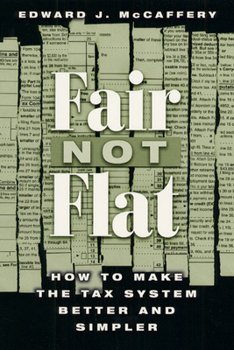
Fair Not Flat: How to Make the Tax System Better and Simpler

Select Format
Select Condition 
Book Overview
Everyone knows that the current tax system is unfair. Some of the richest people in America pay no tax, while a huge share of the tax burden falls on the rest of us. A mere glance at the tax code confirms that it is far too complex, with volumes of rules that no ordinary person could possibly comprehend. What is to be done? Some conservatives have called for a so-called flat tax. But a flat tax is not necessarily a simple tax, and "flat" means "more" for most taxpayers: a rise in middle-class taxes to finance tax cuts for the rich. Is there another choice?
In clear, easy-to-understand language, Edward J. McCaffery proposes a straightforward and fair alternative. A "fair not flat" tax that is consistent and progressive would tax spending, not income and savings. And if it were collected at its lower levels through a national sales tax, most people would not have to file a return. A supplemental tax on spending for the wealthiest individuals would make the national sales tax progressive. Under McCaffery's system, a family of four would pay no tax on their first $20,000 in spending, and 15 percent on the next $60,000. Only the few families who spend more than $80,000 a year would be subject to the supplemental tax. Necessities would be taxed less than ordinary and luxury items. No one would be taxed directly on savings. The estate and gift or so-called death tax would be abolished, for the simple reason that dead people don't spend. The "fair not flat" tax would fall on heirs when and as they spend their good fortune. Perhaps best of all, most Americans would not have to fill out tax returns. Simpler, more efficient, fairer, and more reflective of America's current social values, McCaffery's "fair not flat" tax could help get us out of the tax mess that politicians and special interests have gotten us into, improving the whole country in the process. Read Fair Not Flat to find out how. "In Fair Not Flat, Mr. McCaffery lays out the case for a consumption tax. He does so in a reader-friendly way, presenting his argument with very few footnotes, equations or technical terms. The consumption of the book, so to speak, is not at all taxing. And its argument is well worth pondering."--Bruce Bartlett, Wall Street Journal
In clear, easy-to-understand language, Edward J. McCaffery proposes a straightforward and fair alternative. A "fair not flat" tax that is consistent and progressive would tax spending, not income and savings. And if it were collected at its lower levels through a national sales tax, most people would not have to file a return. A supplemental tax on spending for the wealthiest individuals would make the national sales tax progressive. Under McCaffery's system, a family of four would pay no tax on their first $20,000 in spending, and 15 percent on the next $60,000. Only the few families who spend more than $80,000 a year would be subject to the supplemental tax. Necessities would be taxed less than ordinary and luxury items. No one would be taxed directly on savings. The estate and gift or so-called death tax would be abolished, for the simple reason that dead people don't spend. The "fair not flat" tax would fall on heirs when and as they spend their good fortune. Perhaps best of all, most Americans would not have to fill out tax returns. Simpler, more efficient, fairer, and more reflective of America's current social values, McCaffery's "fair not flat" tax could help get us out of the tax mess that politicians and special interests have gotten us into, improving the whole country in the process. Read Fair Not Flat to find out how. "In Fair Not Flat, Mr. McCaffery lays out the case for a consumption tax. He does so in a reader-friendly way, presenting his argument with very few footnotes, equations or technical terms. The consumption of the book, so to speak, is not at all taxing. And its argument is well worth pondering."--Bruce Bartlett, Wall Street Journal
Format:Hardcover
Language:English
ISBN:0226555607
ISBN13:9780226555607
Release Date:April 2002
Publisher:University of Chicago Press
Length:192 Pages
Weight:1.10 lbs.
Dimensions:9.3" x 0.8" x 6.3"
Customer Reviews
5 ratings
An interesting argument
Published by Thriftbooks.com User , 18 years ago
Should we have a flat tax instead of the present income tax? How about, as the author of this book proposes, a "fair" tax. Edward McCaffery's idea is to tax spending. The argument he gives is simple. The rich can avoid taxes by acquiring assets, avoiding a tax on income, avoiding a death tax, and not having to pay a spending tax. With a spending tax, the rich will still be able to avoid a tax on savings and at death (there won't be a tax on savings or on inheritance). But they will pay a tax on big spending. And that seems a little better for society. Well, maybe that's true. But I think it is more complicated than this. First of all, we pay plenty of taxes: income tax, payroll tax, property tax, sales tax, inheritance tax, and a few miscellaneous fees here and there. Second, the nature of the income tax is not really evident to me. If I make widgets for a living, spend 10 dollars per widget for raw materials, and sell the widgets for 20 dollars each, I understand a little about the effect of an income tax: a 20% tax takes more of my profit than a 10% tax. More important, I know what the effect is if I work twice as hard and make twice as many widgets. But even here, I'm not so sure about all this, because a higher tax may let me raise my price for each widget. When it comes to salaries, I'm really not sure what the effect of an income tax is going to be. I don't see much (or any) of the taxed income: it is taken out of my paycheck before I get it. In some cases, it may be obvious how much the work I do is worth to my company, independent of taxes. But in other cases, my salary is more of a negotiated quantity, and what I'm negotiating is going to be my after-tax salary. It can make my income tax look more like a payroll tax (such as social security) and it can make my employer look more like the entity that actually pays the tax. McCaffrey does not get into this sort of question, nor the significance of higher payroll or property taxes. Well, that may be okay, given that he's proposing spending taxes. But I think it will turn out that these spending taxes wind up being very difficult to collect, and when they are large, there will be more and more loopholes in them too. The author discusses some present tax features (such as disproportionate tax burdens on women), while not mentioning others (such as bracket creep and other effective tax rate changes) which I think have a strategic significance that the author overlooks. I agree with the author on getting rid of the inheritance tax. I would add that under present laws, in the case of inheritance taxes on previously untaxed money, the marginal rate can easily exceed 90% or even 100%: an inheritor can actually lose money by acknowledging the existence of some money in an untaxed IRA. Are loopholes and complexity inevitable in any fair tax system? Maybe so. But I have a counterproposal: make the tax system unfair if necessary but make it simpler. Right now, as the auth
A remarkable learning experience
Published by Thriftbooks.com User , 20 years ago
If you want to learn about taxation this is the book. A clear expose of a tax system that is way out of control and how to fix it. Thank you Mr. McCaffery, you are a true scholar and educator.
A must read for Tax Techies
Published by Thriftbooks.com User , 23 years ago
Any [one] can see that the transaction costs of the current income tax system combined with its accompanying incentive to waste make it unworkable from a wealth maximizing perspective. Anyone who understands the current tax system, even a left-wing, ivy league educated law professor has to admit that a consumption tax, coupled with the elimination of the estate tax would better equip America to reduce transaction costs and incentivize saving. "The Mac" lays it all out for the world to see ... are they looking?
What's wrong with our tax system for dummies AND geniuses
Published by Thriftbooks.com User , 23 years ago
This book is exceptionally well written. It is clear and easy to understand, with examples based in current literature. An important read for anyone who pays taxes.
Insightful and interesting look at the tax system
Published by Thriftbooks.com User , 23 years ago
This book was recommended to me by a friend who loved the book's honesty and insight. This book discusses advanced and interesting ideas which used to be off-limits to all but lawyers and accountants. Mr. McCaffery is engaging and easy to understand. Every taxpayer in America should read this book--It will give you new insights and will demistify the complicated world of tax law.
Copyright © 2025 Thriftbooks.com
Terms of Use | Privacy Policy | Do Not Sell/Share My Personal Information | Cookie Policy | Cookie Preferences | Accessibility Statement
ThriftBooks ® and the ThriftBooks ® logo are registered trademarks of Thrift Books Global, LLC
ThriftBooks ® and the ThriftBooks ® logo are registered trademarks of Thrift Books Global, LLC
