


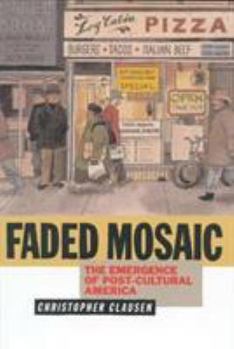
Faded Mosaic: The Emergence of Post-Cultural America

Select Format
Select Condition 
Book Overview
Contrary to today's widespread emphasis on cultural diversity, the United States has become not a multicultural society but the world's first post-cultural society. Cultures, Christopher Clausen argues, have lost power over both public and private behavior. This largely unrecognized transformation has enormous importance for every area of American life, from marriage to politics. One of its most prevalent social expressions is an aimless, conformist individualism-because there is no longer any source of authority or value outside the self. The multiculturalism of leftist politics and the family values of the right are both futile expressions of nostalgia for a world (differently interpreted, of course) that is gone forever. In Faded Mosaic, Mr. Clausen brings his analysis down to earth with telling illustrations from contemporary life. He demonstrates how the moral demands and collective identities of America's native and immigrant cultures have vanished. In striking contrast to societies of the past, he declares, the United States today has neither one big culture nor many smaller ones, only a dizzying mixture of freedom and nostalgia. Original and penetrating, a serious critique.... It is the great virtue of Faded Mosaic that Mr. Clausen describes our present condition without hysterics or posturing-but with the caution, objectivity and concern that the subject deserves. -Eric Cohen, Wall Street Journal
Format:Hardcover
Language:English
ISBN:1566632838
ISBN13:9781566632836
Release Date:March 2000
Publisher:Ivan R. Dee
Length:223 Pages
Weight:0.95 lbs.
Dimensions:8.7" x 1.1" x 6.2"
Customer Reviews
4 ratings
The Culture of Cultural Oblivion
Published by Thriftbooks.com User , 25 years ago
This is a great book, almost a respite from the culture war histrionics that dominate media and academic discourse. In it Clausen talks about "post-culturalism," yet another insipid term for which he apologizes at the book's beginning. It's just gotta be like that, I guess. As a good explanation of his thesis, I'll describe the cover:People are going about their business outside a small restaurant, everything's normal. The restaurant is called "Log Cabin Pizza" and specializes in burgers, tacos, and italian beef. The specials are corned beef sandwiches and Cantonese stirfry. Next to the Log Cabin is a store specializing in religious artifacts and trinkets, of "all religions." Heterogeneity and homogeneity have become the same thing.Clausen has an excellent critique of multiculturalism's theoretical permutations, and its significance for our society. He sort of downplays the idea of any sort of genuine "culture war," however, saying that cultures --and the very term culture-- are just methods to conveniently construct the present, and genuinely signify little in America. He is rather scathing talking about some of the Indian (he insists on calling them Indians) reconstructions of the past to "preserve their culture." All in all a great book for people interested in understanding the paths of American social development, and for those looking for a critique of the culture-vulture flame wars.Another nice thing is that the book is short. It is not some plodding monstrosity of an author's effort to demonstrate he is well read. Instead, Clausen has written a clear and concise book that does not fall into the short book trap of polemics.
Excellent, incisive portrait of postmodern America
Published by Thriftbooks.com User , 25 years ago
This book is one of the best I've read since college on American "culture" and the so-called "culture wars". Clausen defines what he means by culture and post-culture, then shows that America no longer has a culture. What is called "multiculturalism" is racial/racist/victimology pandering manufactured for political use. America today, and increasingly the rest of the civilized world, are monocultural. Post-cultural society is one without authority, either as persons or ideals. But it is also a society of conformist, pseudo-individualists, dominated by narcissism: rejection of fact and rational thought, historically illiterate. What's left of real historical cultures in America has been cannibalized for commercial, political, or academic purposes. Clausen takes an especially fascinating and decisive look at the anthropological concept of "culture", why it applies only to isolated primitive societies, and why cultural "relativism" never made any sense. Our state, outlined by Clausen, was prophesied over a century ago by Tocqueville and Nietzsche, as the "tyranny of the majority" or the mentally enfeebled "last man". It's here, and it's the way we live now, like it or not. It does not bode well for individual freedom or democratic self-government.
Informative, intimate analysis of American culture wars.
Published by Thriftbooks.com User , 26 years ago
Faded Mosaic considers modern American culture, presented by the author as the first post-cultural society existing after the death of culture: after defining the state of post-culturalism, Clausen argues that its effects are transforming American life and creating conformist individuals who don't believe in outer authority figures. Both causes and effects of these culture wars receive intimate analysis in a title recommended for college-level students of sociology.
America, the graveyard of cultures
Published by Thriftbooks.com User , 26 years ago
This book will change the way you think about contemporary American society. With acid wit and one arresting phrase after another, Christopher Clausen shows that the ferocious debate over multiculturalism misses the point. Culture is disappearing in America. Far from being multicultural, America has been a "graveyard of cultures." Ethnic studies programs in American universities "dot the academic world like grave markers after a plague." In what Clausen calls "post-cultural" America, the very word culture has lost its meaning and multiculturalism is little more than a code word for racial identity politics. After reading Clausen's analysis of how modern American usage has emptied culture of its meaning, I have tried to eliminate the word from my vocabulary. But culture babble is so pervasive in our society that it isn't easy. Globalization, pop culture (there's that word again!), and especially mass individualism have caused the death of culture in America. If each individual is free to create himself on whatever model he chooses, culture has lost its function. Clausen is ambivalent about post-cultural America. Although he is pained by the narcissism of modern individualism, the blandness of "McWorld," and the moral paralysis of relativism, he is completely free of nostalgia for imagined pasts. Rather he sees the death of culture in America as a consequence of the struggle for freedom that has been the theme of American history. In any case, there is no going back. Clausen's book, full of insight and wisdom, will help us find our way in post-cultural America.
Copyright © 2026 Thriftbooks.com
Terms of Use | Privacy Policy | Do Not Sell/Share My Personal Information | Cookie Notice | Cookie Preferences | Accessibility Statement
ThriftBooks ® and the ThriftBooks ® logo are registered trademarks of Thrift Books Global, LLC
ThriftBooks ® and the ThriftBooks ® logo are registered trademarks of Thrift Books Global, LLC
