


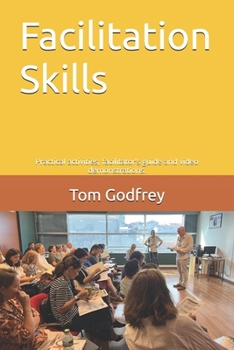
Facilitation Skills: Practical activities, facilitator's guide and video demonstrations.

Facilitation Skills is a practical and reflective handbook for teachers, trainers, and educators who want to move beyond technique and develop the professional judgment, presence, and responsiveness that make learning spaces come alive.
Rather than offering prescriptive "best practices," this book invites readers to rethink teaching through the lens of facilitation: how beliefs shape behaviour, how interaction distributes voice, how risk is managed, and how feedback can support learning without closing it down.
Grounded in classroom observation, teacher education, and facilitated workshops, the book explores facilitation as a developable practice, not a personality trait.
Across seven clearly structured chapters, readers are guided to examine:
Teaching as transmission versus teaching as facilitation
Observable teaching behaviours and the skills that underpin effective facilitation
How ice breakers and warmers shape learning climate and psychological safety
Communication and interaction patterns that widen-or restrict-participation
Structuring interaction to manage risk, voice, and equity
Facilitating discussion and responding thoughtfully to what emerges
Making principled choices about teacher feedback and peer feedback
Each chapter combines accessible theory, concrete classroom examples, suggested video resources, and reflective tasks designed to help readers connect ideas directly to their own practice.
This book will be particularly valuable for:
Language teachers (ELT, EAP, EMI)
Teacher educators and trainers
Facilitators of workshops, seminars, and professional learning
CELTA, DELTA, and CPD participants
Educators interested in learner-centred, performative, and dialogic approaches
At its heart, Facilitation Skills is about learning to notice more: noticing learners, noticing interaction, and noticing oneself as a facilitator. It is a handbook for educators who want to teach with greater intention, confidence, and humanity.
Customer Reviews
ThriftBooks ® and the ThriftBooks ® logo are registered trademarks of Thrift Books Global, LLC
